
How to Search Atlantic County Court Records
The right starting point depends on the record type. New Jersey does not put every case in one database. Superior Court civil and foreclosure cases use the Civil Case Jacket. Criminal cases use the PROMIS/Gavel public access system. Money judgments and liens use the statewide Judgment Search. Traffic tickets and local complaints use Municipal Court Case Search or NJMCDirect. Recorded deeds, mortgages, and liens are kept by the County Clerk, not the courts. Pick the category first, then the matching portal.
Before you start, gather the basics. A full name with correct spelling helps. A docket or case number helps more. New Jersey docket numbers carry meaning. The divorce example FM-01-07500-00 shows FM for a family dissolution case, 01 for Atlantic County, and 00 for the year 2000. Knowing the county code keeps your search local.
- Open the NJ Courts Find a Case page and pick the system that matches your case type.
- Enter a party name or, if you have it, the docket number with its exact prefix and county code.
- Narrow by court type, division, or county so Atlantic County results rise to the top.
- Review the docket entries, party status, hearing dates, and listed documents.
- Request a certified copy through the court or Superior Court Clerk if you need an official record.
The Atlantic County Judicial System
New Jersey runs a single statewide trial court of general jurisdiction, the Superior Court. Atlantic County belongs to the Atlantic/Cape May Vicinage, sometimes called Vicinage 1. There is no locally elected "district court" here the way some other states use that term. Instead, civil, criminal, family, and probate-related matters all fall under the Superior Court umbrella, then split among divisions, offices, and buildings. The vicinage page lists the main buildings and the central contact number.
Below the Superior Court sit the municipal courts. They hear traffic tickets, parking tickets, local ordinance violations, disorderly persons offenses, and many first appearances. Atlantic County also runs a Central Municipal Court that serves nine towns from one office. Appeals from the trial divisions go up to the Superior Court, Appellate Division, and the Supreme Court of New Jersey is the final word on state law.
The NJ Courts vicinage page lists the buildings, hours, and the assignment judge for Atlantic County. The image below shows that page.
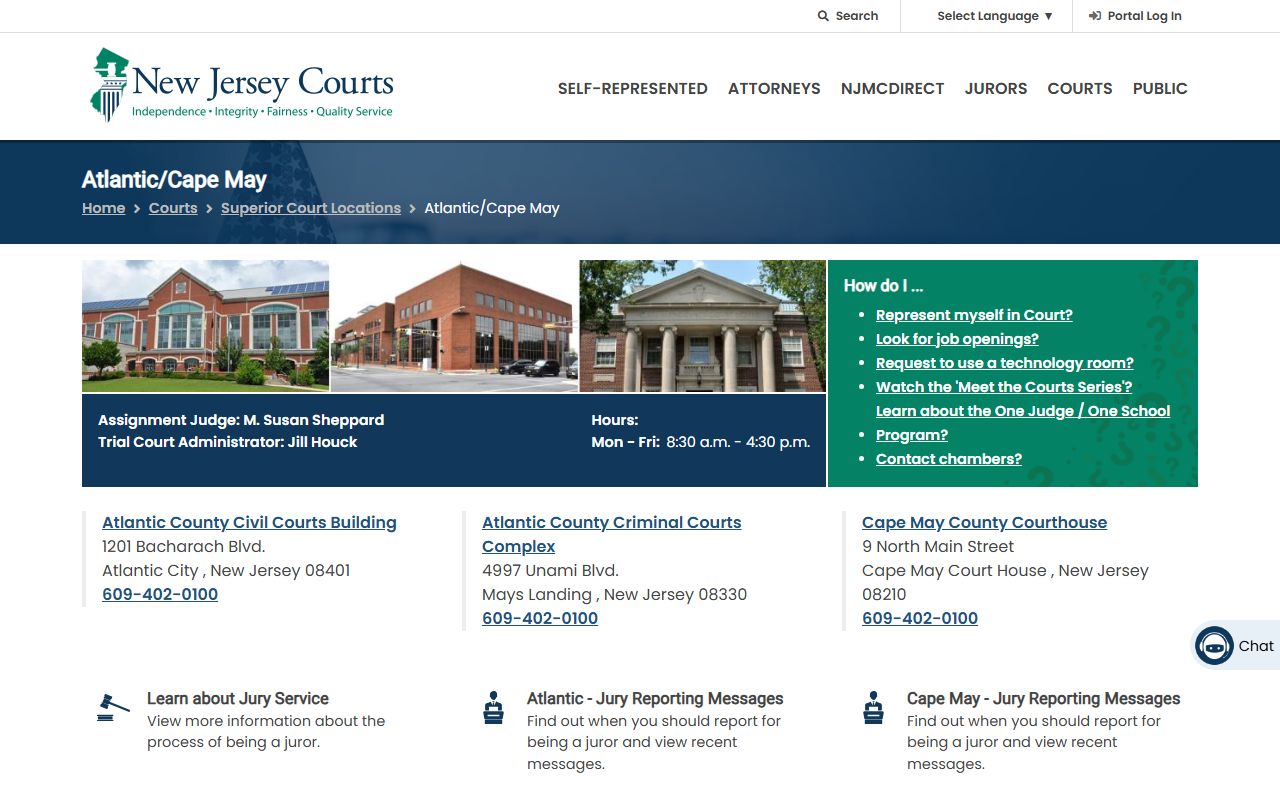
That page is the cleanest official map of where Atlantic County court business actually happens, from the Atlantic City civil building to the Mays Landing criminal complex.
Case flow: Municipal Court › Superior Court (Law or Chancery Division) › Appellate Division › Supreme Court of New Jersey
| Court | Jurisdiction | Case Types |
|---|---|---|
| Supreme Court of New Jersey | Highest state court | Final appeals, court rules, attorney discipline |
| Superior Court, Appellate Division | Intermediate appeals | Appeals from trial divisions, Tax Court, agency actions |
| Superior Court, Law Division | General trial court | Civil claims, criminal indictable offenses |
| Superior Court, Chancery Division | Equity and family | Family, divorce, probate disputes, equity |
| Municipal Courts | Limited jurisdiction | Traffic, parking, ordinances, disorderly persons |
Superior Court vs Municipal Court
People often mix up these two levels. The difference decides which portal to use and which office to call. Serious crimes and most lawsuits are Superior Court matters. A speeding ticket or a local code violation is a municipal matter. Some municipal cases can be paid or resolved online, while indictable offenses move into Superior Court criminal processing.
| Feature | Superior Court | Municipal Court |
|---|---|---|
| Level | General jurisdiction trial court | Limited jurisdiction local court |
| Typical cases | Felony-level crimes, civil suits, divorce, probate disputes | Traffic, parking, ordinances, low-level offenses |
| Where to search | Civil Case Jacket, PROMIS/Gavel, Judgment Search | Municipal Court Case Search, NJMCDirect |
| Atlantic County site | Atlantic City civil, Mays Landing criminal | Central Municipal Court and town courts |
More detail on the trial court sits on the Atlantic County Superior Court page, and traffic matters are covered on the traffic court records page.
Atlantic County Courthouses
Court business is spread across several buildings, mostly in Mays Landing and Atlantic City. The Mays Landing campus is dense. The Criminal Courts Complex, Central Municipal Court, the County Clerk's historic main office, the Surrogate, and the county jail all sit close together. A visitor who only knows the word "courthouse" can easily end up at the wrong door, so confirm the building before you go.
Atlantic County Criminal Courts Complex
4997 Unami Boulevard
Mays Landing, NJ 08330
609-402-0100
Atlantic County Civil Courts Building
1201 Bacharach Boulevard
Atlantic City, NJ 08401
609-402-0100
Types of Court Records Available in Atlantic County
Atlantic County court records cover a wide span of case types. Each type is produced by a different division and follows different access rules. Civil and criminal files come from the Superior Court Law Division. Family files, including divorce, come from the Chancery Division Family Part. Probate files run through the Surrogate. Traffic and local matters stay in municipal court. Knowing the type tells you both the portal and the office.
Here are the main categories you can look up.
- Criminal records - indictable offenses and post-indictment proceedings handled in Superior Court.
- Civil records - lawsuits, contract disputes, and foreclosure case jackets.
- Family and divorce records - dissolution, custody, and support filings in the Family Part.
- Probate records - wills and estate administration through the Surrogate's Court.
- Traffic records - tickets, parking, and local complaints in municipal court.
What Atlantic County Court Records Show
A court record is built from many small fields. The Judiciary's Electronic Access Program describes the data a public case search can include. That list covers the case number, the parties and their status, attorneys, documents filed, orders entered, scheduled proceedings, and motion outcomes. The actual text or image of a filed document is usually not part of the online case information. For that, you request a copy.
| Field | What It Shows |
|---|---|
| Case Number | Docket number with case-type prefix, county code, sequence, and year |
| Filing Date | When the case opened in the court division |
| Parties | Plaintiff, defendant, petitioner, respondent, or estate names and status |
| Charges / Cause | The charge in a criminal case or the cause of action in a civil case |
| Disposition | How a charge, claim, or case was resolved |
| Sentence / Judgment | The final order, money judgment, or sentence entered |
The Electronic Access Program page sets out which systems feed this data and what is left out.
Public Access Laws for Atlantic County Court Records
New Jersey uses two separate access systems, and mixing them up is the most common mistake. County agency records, such as Clerk, Sheriff, and budget documents, fall under the Open Public Records Act, or OPRA. Court case records do not. The Judiciary is not an OPRA public agency. Court records are presumptively open under New Jersey Court Rule 1:38, but that same rule excludes or redacts confidential categories. So do not file an OPRA request for a divorce judgment, and do not expect the County Clerk to hold Family Division files.
Key Statutes:
N.J.S.A. 47:1A-1 - OPRA's policy that government records should be readily accessible unless protected.
Court Rule 1:38 - presumes court records are open while listing the confidential exclusions.
N.J.S.A. 2C:52-1 - expungement law that isolates eligible criminal records from public view.
N.J.S.A. 2C:7-1 - Megan's Law registration and public notification rules.
Records That Are Restricted or Confidential
Not every court record is open to the public. Rule 1:38 and several statutes wall off sensitive material. Juvenile delinquency files, adoption records, child welfare matters, and many domestic violence filings are restricted. Mental health and medical data are protected. Grand jury records stay closed unless they become part of a public proceeding. Sealed and expunged records do not appear in ordinary searches. Personal identifiers like Social Security and financial account numbers are redacted from public copies.
A petition is sometimes possible. To view a sealed record, a person usually needs a court order showing good cause, and the request goes to the court that holds the file. Expunged records are handled under the expungement law, with limited access kept for law enforcement and courts. When a search turns up nothing, that is not proof a record never existed. The case may be sealed, restricted, misspelled, filed under a business name, or simply too old for the online index.
Specialty Courts in Atlantic County
New Jersey runs court-supervised treatment programs known as Recovery Court, the program once called Drug Court. It combines close supervision, treatment, frequent court reviews, drug testing, and a mix of sanctions and incentives for eligible defendants with substance-use disorders. Atlantic County takes part through the Atlantic/Cape May Vicinage. Eligibility turns on the charges, a clinical assessment, criminal history, and public-safety screening.
The county's Central Municipal Court is a second standout. It is not a treatment court, but it is an unusual shared-services model. One office handles municipal court work for nine towns, with its own judges, administrators, prosecutors, and a public defender pathway. In 2025 the county added an AI communications pilot that sends 24/7 text-message court information in English and Spanish, including hearing links, schedules, and contacts.
Atlantic County Sheriff and Jail
The Atlantic County Sheriff's Office, led by Sheriff Joseph A. O'Donoghue, runs court security, transportation, the fugitive squad, and the warrant unit from the Mays Landing criminal complex. The Sheriff publishes a Most Wanted page but does not post a full public warrant database. Jail operations are separate. The Department of Public Safety, Division of Adult Detention, runs the Gerard L. Gormley Justice Facility on Atlantic Avenue in Mays Landing.
Atlantic County does not publish an official online jail roster. Custody questions go by phone. For the full roster and lookup picture, see Atlantic County inmate records, and for active warrants see the warrant records page. Release verification is covered on the released inmates page.
Marriage, Divorce, and Surrogate Records
Marriage licenses come from the local municipal registrar, not the courts, and the County Clerk performs free wedding ceremonies. Divorce is a Family Part matter, and a Certificate of Divorce is often enough for proof. Probate runs through the Surrogate. See marriage and divorce records and the Surrogate's Court page for the full process.
- Testator
- The person who made a will.
- Executor
- The person named in a will to settle the estate.
- Short certificate
- Surrogate-issued proof that an executor or administrator has authority to act for an estate.
Atlantic County Record Fees
Fees depend on the office and the record. The County Clerk charges recording fees for land documents. The Surrogate charges to probate a will. The state sets the marriage license fee. Superior Court copy and certified-record costs are set through NJ Courts request channels, so confirm those with the court when you order. The table below lists documented fees from the County Clerk, Surrogate, and state vital records pages.
| Item | Amount |
|---|---|
| Deed recording, first page | $40 |
| Trade Name Certificate | $50 |
| Federal tax lien filing | $25 |
| Marriage license application | $28 |
| Probate of a will (starting at) | $100 |
Note: Recording and probate fees are paid to county offices, while court case copy fees are set separately through the Judiciary.
How to Interpret Atlantic County Court Records
Reading a docket takes a little practice. The docket number is the key. Use its exact punctuation and prefix when you call the court or order copies. Party status can read as active, defaulted, dismissed, settled, or substituted, and one party's status can change without the whole case ending. A "disposed" or "closed" tag usually means a final action, but appeals, post-judgment motions, or enforcement can still follow.
Charges are not the same as convictions. A criminal case search may show a charge that was later dismissed, downgraded, or never proven. A civil judgment can appear in Judgment Search and affect property or credit even when the underlying case jacket sits in a different system. When a docket lists a document but shows no PDF, the file still exists; you just need to request the copy.
Accuracy and Record Limitations
Online systems lag real events. A bond posted at night, a transfer to state prison, or a warrant recall may take time to show up. Public portals are also not criminal-history checks. Employers, licensing boards, and immigration cases often need fingerprint-based checks through State Police or FBI channels, not a name search on a court site.
Note: Confirm any detail that affects custody, travel, or legal rights with the office that holds the record before you rely on an online result.
History of Atlantic County Courts
Atlantic County was created by the New Jersey Legislature in February 1837, with its first freeholder board seated in May of that year. The county seat is Mays Landing. The county's recordkeeping identity still ties back to the Historic Court House Complex at 5901 Main Street, where the County Clerk keeps the main office today. The Clerk handles a recently launched website serving recording, weddings, trade names, and office contacts.
The Surrogate's Office offers a memorable history note. The title "Surrogate" comes from colonial practice, when the county surrogate stood in for the Governor, who in 1710 received authority to probate wills and issue marriage licenses. The same office still files wills and estate documents now. On the jail side, the Gerard L. Gormley Justice Facility opened in 1985 and runs its own certified Correction Officers Academy first graduated in 1998.
County Clerk and Recorded Documents
The Atlantic County Clerk, Joseph J. Giralo, is a separate elected official from the courts. The office records deeds, mortgages, liens, and trade names, runs notary and passport services, posts property fraud alerts, and performs weddings. Land and recorded instruments are searched through the Clerk's Official Records Public Search, which gives free guest access to the index with no password.
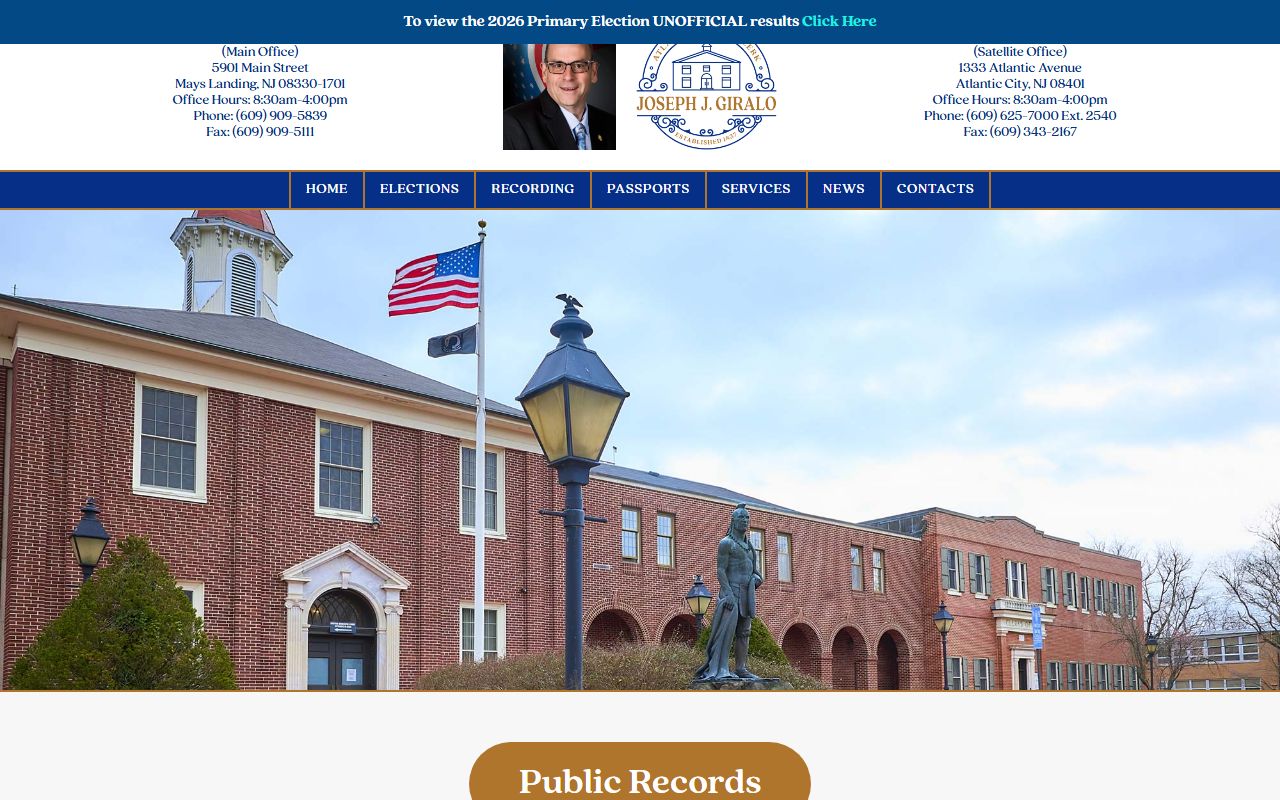
The County Clerk homepage links the recording fees, the public search portal, and the wedding service. For the full picture of the two clerk roles, see the Clerk of Court and Atlantic County Clerk pages.
Frequently Asked Questions
How do I search Atlantic County Superior Court records?
Start at NJ Courts Find a Case, then pick the system that fits the case type. Civil and foreclosure jackets search by party name or docket number. Criminal case information comes through PROMIS/Gavel. Judgment liens use Judgment Search. For certified copies, use the Judiciary's records request process, not the County Clerk's land portal.
Does Atlantic County have an online inmate search?
No official public, searchable jail roster was located in county sources. The county lists jail records at 609-909-7551 and the Justice Facility main line at 609-645-5855. Use NJDOC for state-prison inmates and the BOP locator for federal inmates. More detail sits on the inmate records page.
Are Atlantic County court records covered by OPRA?
No. The Government Records Council says the Judicial branch is not a public agency under OPRA. Courts use their own disclosure policy and Rule 1:38. OPRA still applies to county executive agencies and many local government records. See the public records page for the OPRA request process.
More answers sit on the Atlantic County Court Records FAQ page.