
New Jersey Court Hierarchy for Atlantic County
New Jersey uses a unified statewide court system. There is no locally elected "district court" the way some other states operate. Instead, the Superior Court sits as the single trial court of general jurisdiction for the entire state, organized into vicinages by county grouping. Atlantic County belongs to Vicinage 1, the Atlantic/Cape May Vicinage. Each vicinage has an Assignment Judge who oversees the docket and administration for that group of counties.
Below the Superior Court sit the Municipal Courts. They hear traffic violations, parking tickets, local ordinance matters, disorderly persons offenses, and petty disorderly persons offenses. Those are limited-jurisdiction courts, meaning they cannot hear felony-level cases or full civil suits. Atlantic County also runs a Central Municipal Court that consolidates services for nine municipalities from one office in Mays Landing. At the top of the state system sits the Supreme Court of New Jersey, which takes final appeals and sets court rules. In the middle, the Superior Court, Appellate Division, handles appeals from trial-level orders, Tax Court, and final agency actions.
| Court | Jurisdiction | Case Types |
|---|---|---|
| Supreme Court of New Jersey | Highest state court | Final appeals, court rules, attorney discipline |
| Superior Court, Appellate Division | Intermediate appellate court | Appeals from trial divisions, Tax Court, state agency actions |
| Superior Court, Law Division | General trial court | Civil claims, indictable criminal offenses |
| Superior Court, Chancery Division | Equity, family, probate | Divorce, custody, support, guardianship, equity, probate disputes |
| Tax Court | Statewide specialized | Property tax appeals, state tax disputes |
| Municipal Courts | Limited jurisdiction | Traffic, parking, ordinances, disorderly persons |
Note: The Tax Court is a separate statewide court, not a division of the Superior Court, though appeals from Tax Court go to the Appellate Division.
Atlantic County Superior Court Buildings
Atlantic County's Superior Court business is split by subject matter and location. Civil matters are handled at the Atlantic County Civil Courts Building in Atlantic City. Criminal matters go to the Atlantic County Criminal Courts Complex in Mays Landing. Both buildings operate under the same vicinage phone number, 609-402-0100, and share standard NJ Courts vicinage hours of Monday through Friday, 8:30 a.m. to 4:30 p.m. The Atlantic County Sheriff's Office provides court security and transportation at both locations.
Probate-related functions are nearby but not inside the courthouse. The Atlantic County Surrogate's Office at 5911 Main Street, Mays Landing, serves as both a county department and the local arm of the Superior Court, Chancery Division, Probate Part. The Surrogate keeps a second office in Atlantic City at 1201 Bacharach Boulevard. The Mays Landing government campus concentrates a lot of court activity in one area. The Criminal Courts Complex, Central Municipal Court, County Clerk main office, Surrogate, and the county jail are all within a short distance of each other on or near Main Street and Unami Boulevard.
Atlantic County Civil Courts Building
1201 Bacharach Boulevard
Atlantic City, NJ 08401
609-402-0100
Hours: Mon-Fri 8:30 a.m.-4:30 p.m.
Atlantic County Criminal Courts Complex
4997 Unami Boulevard
Mays Landing, NJ 08330
609-402-0100 / Sheriff 609-909-7200
Hours: Mon-Fri 8:30 a.m.-4:30 p.m.
Atlantic County Superior Court Divisions
The Superior Court is divided into two main trial branches, the Law Division and the Chancery Division. Each handles a different class of cases, and they operate in different buildings in Atlantic County. Knowing the division tells you which building to visit, which clerk's office to contact, and which search portal to use.
The Law Division covers general civil matters in its Civil Part and indictable criminal offenses in its Criminal Part. Civil Part cases include personal injury, contract disputes, foreclosure, and professional liability claims. The Criminal Part handles indictable offenses, which are the more serious crimes that go through a grand jury or accusation process before trial. The Civil Part operates primarily out of the Civil Courts Building in Atlantic City, while Criminal Part business runs from the Criminal Courts Complex in Mays Landing.
The Chancery Division has two parts that matter to most Atlantic County residents. The Family Part handles divorce, legal separation, annulment, custody, child support, alimony, domestic violence, adoption, and juvenile delinquency matters. Family matters are generally filed at the county level and heard locally. The Probate Part of the Chancery Division handles estate administration, will probate, guardianship, and related filings, but in Atlantic County that work runs through the Surrogate's Office, which acts as Deputy Clerk of Superior Court, Chancery Division, Probate Part. Contested probate matters and certain guardianship disputes can be referred to a Superior Court judge for resolution. See the Surrogate's Court page for full probate detail.
- Law Division, Civil Part
- Civil claims, foreclosure, contract disputes, personal injury, money judgments. Atlantic City building.
- Law Division, Criminal Part
- Indictable offenses handled via grand jury indictment or accusation. Mays Landing building.
- Chancery Division, Family Part
- Divorce, custody, support, domestic violence, adoption, juvenile delinquency. County-level filing.
- Chancery Division, Probate Part
- Will probate, estate administration, guardianship. Handled through the Atlantic County Surrogate's Office.
Atlantic County Superior Court vs Municipal Court
People often contact the wrong office because they mix up these two court levels. The difference is not just about the severity of a charge. It also decides which online portal to use, which building to visit, and which phone number to call. A traffic ticket is a municipal matter. A felony-level drug charge is a Superior Court matter. The division below shows the key differences that apply in Atlantic County.
| Feature | Superior Court | Municipal Court |
|---|---|---|
| Level | General jurisdiction trial court, statewide system | Limited jurisdiction, local or shared-services court |
| Case types | Indictable crimes, civil suits, divorce, probate disputes, equity | Traffic, parking, local ordinances, disorderly persons, petty disorderly persons |
| Where to search | Civil Case Jacket, PROMIS/Gavel, NJ Judgment Search | Municipal Court Case Search, NJMCDirect |
| Atlantic County building | Civil Courts Building (Atlantic City) or Criminal Courts Complex (Mays Landing) | Central Municipal Court, 5905 Main Street, Mays Landing, or individual town courts |
| Appeals go to | Superior Court, Appellate Division | Superior Court, Law Division (de novo appeal) |
For Atlantic County court records across both levels, the NJ Courts search portals are the official starting point. For court docket searches by case number or party name, the Civil Case Jacket and PROMIS/Gavel systems handle the Superior Court side.
How a Case Moves Through Atlantic County Courts
A case does not travel in a straight line. The path depends on whether it is criminal or civil, and on what happens at each stage. Understanding the flow helps when you are looking up a case and the status does not match what you expected. A case marked "active" may still be moving through pretrial stages; one marked "disposed" may still have post-judgment motions or an appeal pending.
For criminal indictable cases, the path generally starts with an arrest and a first appearance before a judge, where conditions of release are set. If the matter is indictable, it moves to the grand jury process or an accusation, then arraignment, pretrial motions, and trial or plea. Sentencing follows conviction. Appeals go to the Appellate Division, then the Supreme Court of New Jersey if the court grants certification.
Criminal case flow: Arrest › First Appearance / Detention Hearing › Grand Jury Indictment or Accusation › Arraignment › Pretrial Motions › Trial or Plea › Sentencing › Superior Court, Appellate Division › Supreme Court of New Jersey
Civil cases start with a complaint filed in the Law Division or Chancery Division, depending on the claim. The defendant answers, discovery follows, then mediation or case management, and eventually trial or settlement. A judgment can be appealed. If a money judgment enters, the winning party can record it as a lien and enforce it through garnishment or other processes. The statewide Judgment Search reflects civil judgment liens from 1984 forward.
Civil case flow: Complaint Filed › Answer › Discovery › Mediation / Case Management › Trial or Settlement › Judgment › Superior Court, Appellate Division › Supreme Court of New Jersey
Municipal Court cases follow a shorter track. Most traffic and local matters are resolved by appearance, plea, or payment. Appeals from Municipal Court go to the Superior Court, Law Division, as a fresh hearing called a de novo appeal. That is different from a Superior Court appeal, which reviews the record rather than starting over.
Municipal Court case flow: Complaint / Summons › Municipal Court Appearance or Online Resolution › Municipal Court Judgment › Superior Court, Law Division (de novo appeal if contested)
Atlantic County Vicinage and Municipal Courts
Atlantic County is part of Vicinage 1, the Atlantic/Cape May Vicinage. The vicinage groups two counties under one Assignment Judge and one administrative structure. That judge oversees the docket across all divisions and both counties. The NJ Courts vicinage page for Mays Landing lists the buildings, hours, and main vicinage contact.
Municipal Courts sit below the Superior Court and handle limited-jurisdiction matters. Atlantic County has both individual municipal courts in each town and a Central Municipal Court that serves nine municipalities from one building. The Central Municipal Court at 5905 Main Street, Mays Landing, 609-909-5999, handles cases from Corbin City, Egg Harbor Township, Estell Manor, Galloway Township, Hamilton Township, Linwood, Port Republic, Ventnor, and Weymouth Township. As of January 2026, the court email is atlcentral.mc@njcourts.gov. The court operates its own judge panel, administrator team, and dedicated prosecutor assignments by team. In 2025, Atlantic County launched an AI communications pilot through the Central Municipal Court that delivers 24/7 court information by text message in English and Spanish.
Judges of the Central Municipal Court include Hon. James P. Grimley, C.J.M.C., Hon. Timothy P. Maguire, Hon. Carl Tripician, Hon. Linda M. Goff, Hon. Andrew Roseman, Hon. Joseph Lisa, and Hon. Robert Morello. Court administration is led by Court Administrator Antoinette Tummon, C.M.C.A., with Deputy Administrators Patricia Campbell, Laura Garvey-Santoro, Lisa Belgrave, and Kimberly Trivelli.
Note: Building access for the Central Municipal Court is only available from the parking lot behind the courthouse at 5905 Main Street.
Search Atlantic County Superior Court Records
NJ Courts provides separate public portals for different record types. Each portal requires a different set of search inputs and covers a different slice of the docket. Start by deciding what kind of case you are looking for, then pick the right system. Searching in the wrong portal will return no results even when a case exists.
- Go to the NJ Courts Find a Case landing page. It lists the available systems with links to each.
- For civil Superior Court cases, use the Civil Case Jacket portal. Search by party name or docket number. Select Atlantic County from the county dropdown to focus results.
- For criminal Superior Court cases, use the PROMIS/Gavel public access system. Enter the defendant name or case identifier, accept the disclaimer, and review results.
- For money judgments and civil liens, use the statewide Judgment Search at portal.njcourts.gov. Search by party name, judgment number, or docket number. Results cover 1984 to present statewide.
- For municipal traffic or complaint matters, use Municipal Court Case Search or NJMCDirect. You will need the court ID number, ticket number, and license number for traffic lookups.
- If you need a certified copy, contact the court clerk or use the NJ Courts copy-request process. Online portals show docket entries but do not provide document images through public access.
NJ docket numbers carry county and case-type information. The prefix FM identifies a family dissolution case. The two-digit county code for Atlantic County is 01. A docket reading FM-01-07500-00 means a family dissolution case in Atlantic County filed in 2000 with sequence number 07500. Knowing this helps when you call the court, request copies, or narrow an online search.
| System | Covers | Search Inputs |
|---|---|---|
| Civil Case Jacket | Civil and foreclosure case jackets | Party name or docket number; county dropdown |
| PROMIS/Gavel | Criminal indictable cases | Defendant name, county, case identifiers; disclaimer required |
| Judgment Search | Civil judgment and order docket liens, 1984-present | Party name, judgment number, or docket number |
| Tax Court Search | Tax Court matters | Party name, docket number, or block/lot |
| Municipal Court Case Search | Municipal complaints and tickets | Ticket number or complaint number |
| NJMCdirect | Traffic ticket payment and case resolution | Court ID, ticket number, license number |
Atlantic County Superior Court Records and Public Access
Court records in New Jersey are not governed by the Open Public Records Act, or OPRA. The Government Records Council says the Judicial branch is not a public agency under OPRA. Instead, court records are presumptively open under New Jersey Court Rule 1:38, which lists the categories excluded or redacted from public access. Those categories include juvenile delinquency records, adoption files, child abuse and neglect cases, certain domestic violence filings, mental health and medical data, grand jury proceedings, search warrant material before execution, sealed records, expunged records, and confidential personal identifiers such as Social Security numbers and financial account numbers.
The practical result is that you should not file an OPRA request for a Superior Court divorce judgment or a criminal case jacket. Those go through the Judiciary's own records request process. OPRA does apply to county agency administrative records, such as county budgets, contracts, and records held by the Sheriff or County Clerk as county departments. If a Superior Court portal shows no result, that does not confirm there is no record. The case may be sealed, restricted by rule, filed under a different name, misspelled, or predating the online index. For any legal, employment, or immigration use, verify with the court or clerk that holds the file.
The Electronic Access Program, or EAP, describes what the public portals actually show. Case information can include case number, party names and status, attorneys, documents filed, orders entered, hearing schedules, and motion outcomes. Actual text or images of filed documents are generally not part of the online case information. To get a document, you request a copy.
Copy types:
Plain copy - an ordinary copy of a public record without court seal or certification.
Certified copy - certified by the custodian as a true copy; often required for legal proceedings.
Exemplified copy - enhanced certification sometimes needed for use outside New Jersey; verify availability with the issuing court.
Certificate of Divorce - often enough as proof of dissolution; available through the Superior Court Clerk; contains county, docket number, party names, and final judgment date.
Superior Court Clerk and Vicinage Offices
The Superior Court Clerk, through the vicinage offices, handles court records for the Atlantic County Superior Court. That is different from the elected Atlantic County Clerk, who records deeds, mortgages, and other land instruments. The two offices handle different records and are located in different buildings. Confusing them is one of the most common mistakes people make when requesting records.
Court records from the Family Division, such as closed divorce files, are eventually archived by the Superior Court Clerk's Office warehouse in Trenton. Timing varies by county. For active case files, contact the appropriate division at the relevant building. For older closed files, you may need to contact the Superior Court Clerk's Office with the docket number, party names, case type, county code, and approximate year. The Clerk of Court page covers the vicinage court offices in more detail. The Atlantic County Clerk page covers the recording office run by County Clerk Joseph J. Giralo.
Note: The Surrogate's Office serves as Deputy Clerk of Superior Court, Chancery Division, Probate Part, so probate and estate records are filed with the Surrogate, not through the general court clerk offices.
Federal Courts for Atlantic County
Atlantic County is part of the U.S. District Court for the District of New Jersey. The district has three courthouses: Camden, Newark, and Trenton. For Atlantic County residents and cases, the practical federal courthouse is in Camden. The Mitchell H. Cohen Building and U.S. Courthouse is at 4th and Cooper Streets, Camden, NJ 08101, phone 856-757-5021. Federal civil and criminal matters involving Atlantic County parties can include federal crimes, civil rights claims, employment discrimination, constitutional cases, diversity jurisdiction civil suits, and prisoner civil rights filings.
The U.S. District Court for the District of New Jersey uses CM/ECF for electronic filing and PACER for public docket access. PACER requires registration. There is a per-page fee for accessing documents, though a quarterly spending threshold applies before fees kick in and some categories of users have fee waivers. Attorneys of record have fuller access through CM/ECF; the public uses PACER. CourtListener can provide free access to many opinions, but it is not a substitute for the official docket when you need complete, current case information.
The district court homepage links the CM/ECF login, filing guides, local rules, and case management resources for the District of New Jersey.
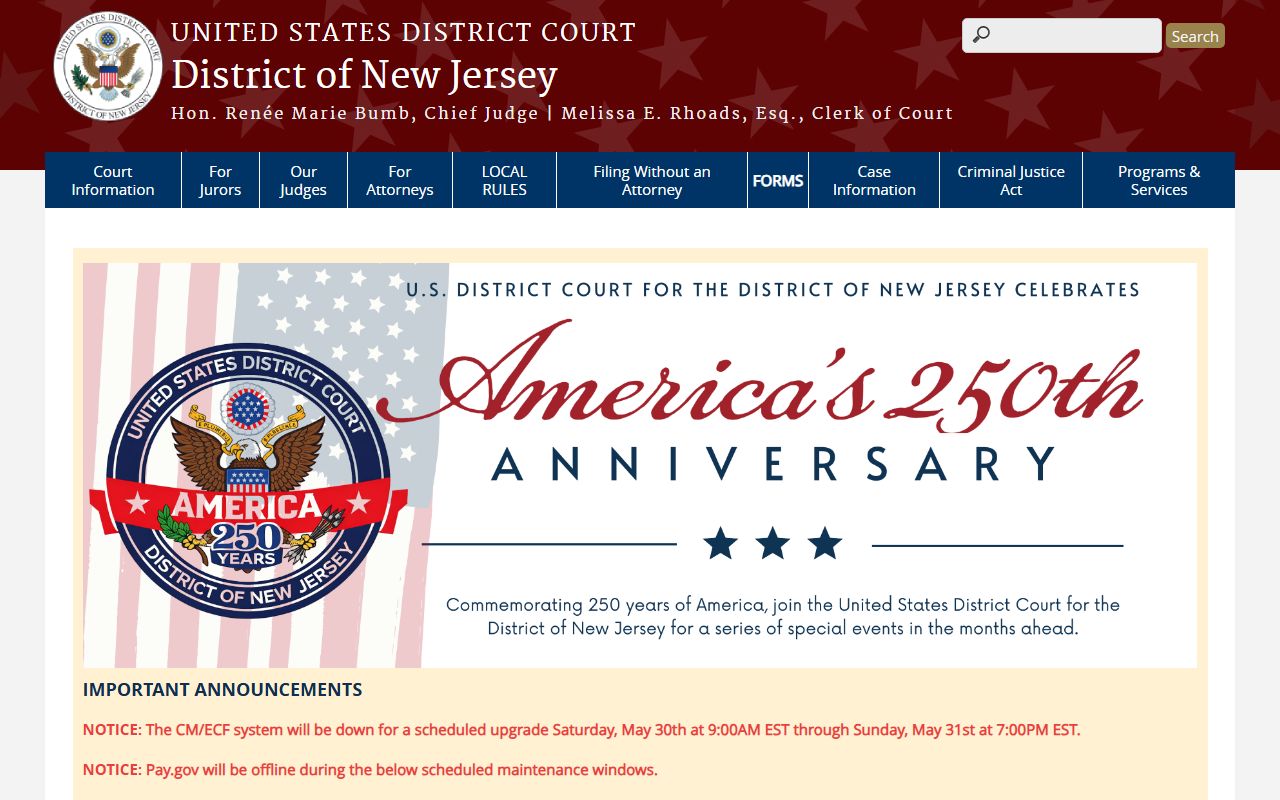
The district court website is the official source for local rules, judge information, and electronic case filing instructions for federal matters involving Atlantic County.
Federal appeals from the District of New Jersey go to the U.S. Court of Appeals for the Third Circuit. The Third Circuit covers New Jersey, Pennsylvania, Delaware, and the U.S. Virgin Islands. Atlantic County cases that reach the appellate level go through this court before any possible petition to the U.S. Supreme Court. The Third Circuit publishes opinions and docket information through its own portal, which also links to PACER for full docket access.
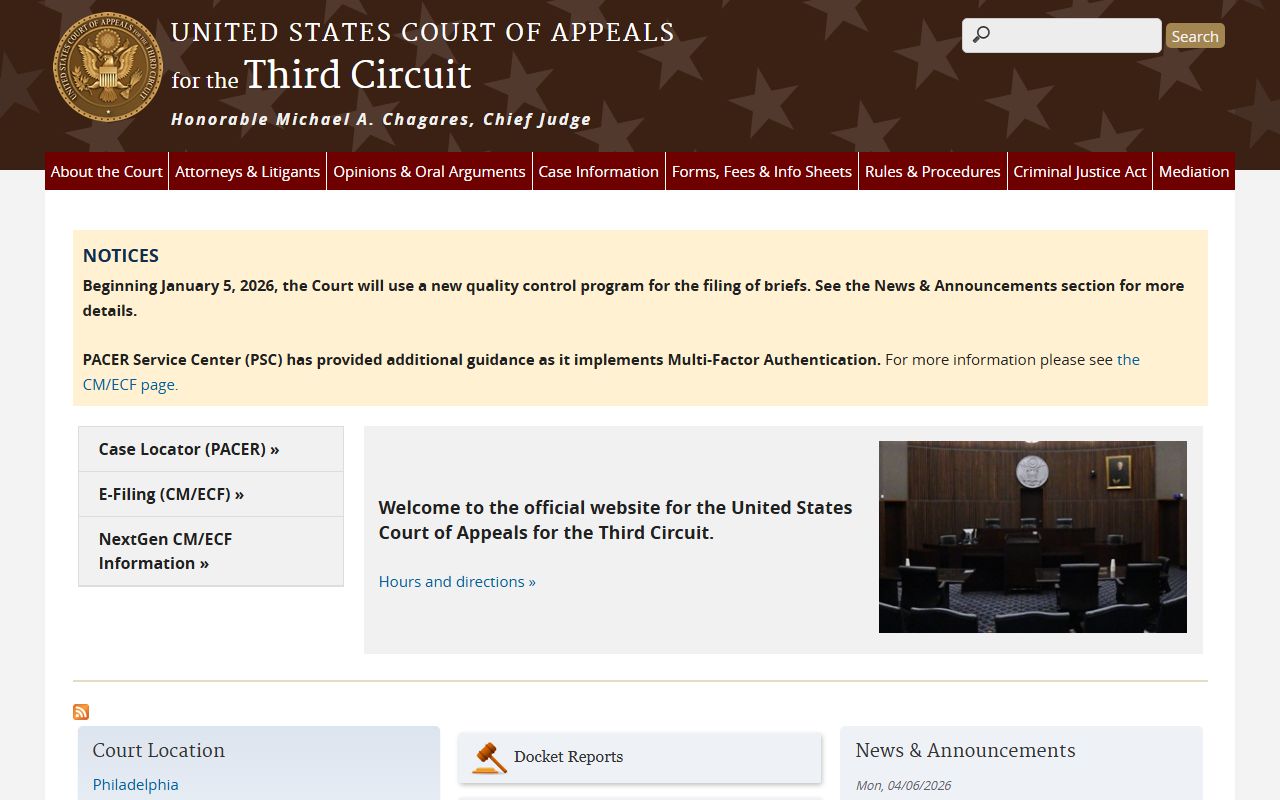
The U.S. Court of Appeals for the Third Circuit handles appeals from the District of New Jersey, including cases originating in Atlantic County.
PACER and Public Federal Docket Access
PACER, the Public Access to Court Electronic Records system, is the standard way for members of the public to view federal court dockets. It covers district courts, bankruptcy courts, and appellate courts across the country. Registration is free. Charges apply when viewing case documents above the quarterly threshold. For Atlantic County federal cases, PACER searches can be run at the district level for the District of New Jersey or at the national level if the case may involve a different district.
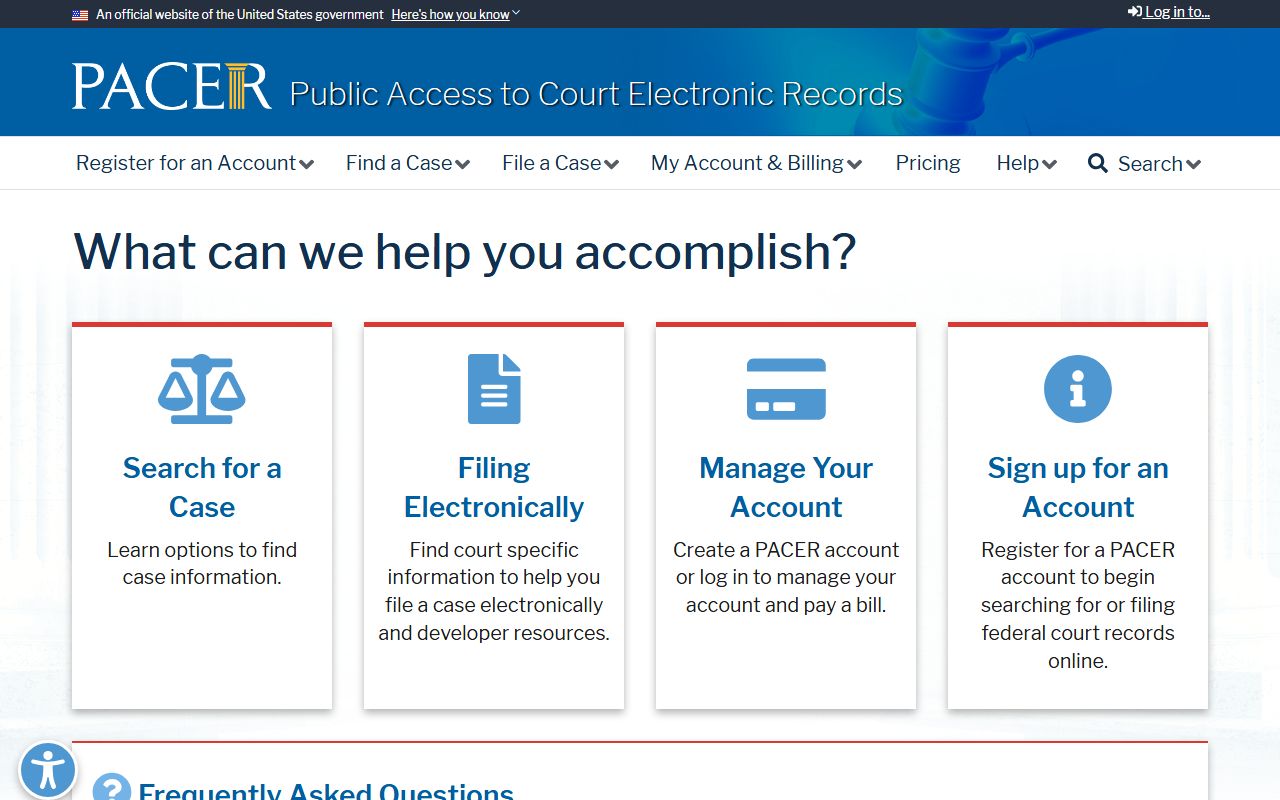
The PACER portal allows the public to register and search federal dockets for cases in the District of New Jersey and other federal courts nationwide.
U.S. Bankruptcy Court for Atlantic County
Bankruptcy matters for Atlantic County are handled by the U.S. Bankruptcy Court for the District of New Jersey, Camden vicinage. The bankruptcy court's directions page lists two Camden locations: 401 Market Street, Second Floor, Camden, NJ 08101, and 400 Cooper Street, Fourth Floor, Camden, NJ 08101. The Camden vicinage of the bankruptcy court covers Atlantic County and other South Jersey counties. Chapter 7 liquidation, Chapter 11 reorganization, Chapter 12 family farmer and fisherman cases, and Chapter 13 wage-earner plans are all filed here. PACER also provides public access to bankruptcy dockets for the District of New Jersey.
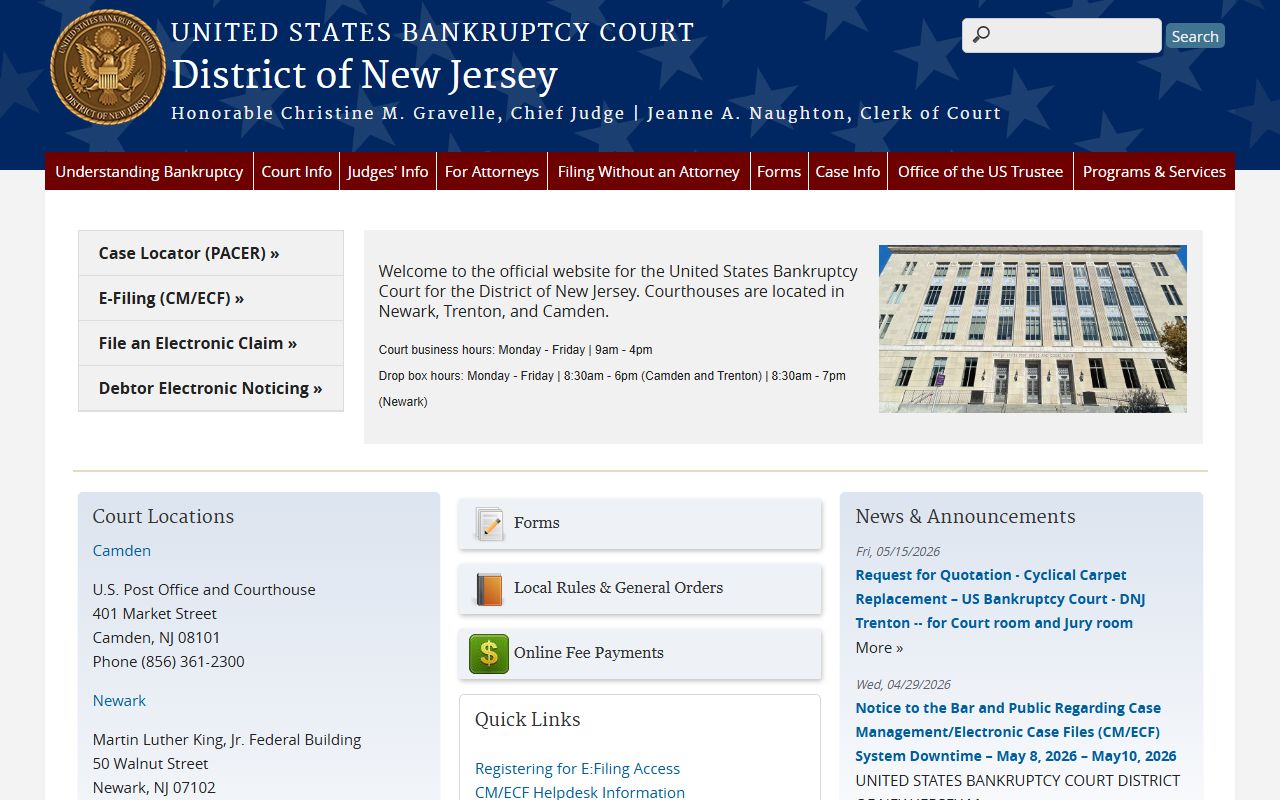
The U.S. Bankruptcy Court for the District of New Jersey handles all Chapter 7, 11, 12, and 13 filings for Atlantic County through the Camden vicinage.
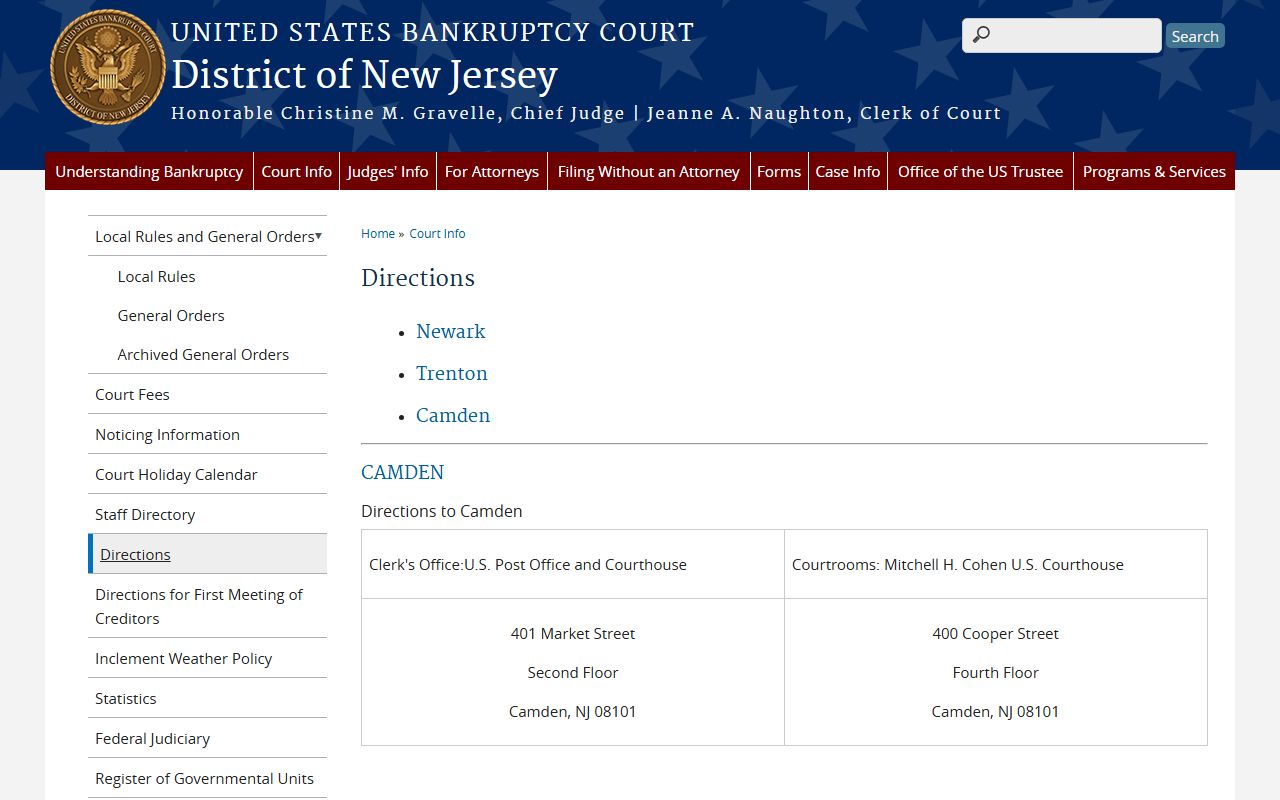
The bankruptcy court directions page lists the Camden courthouse addresses and floor information for in-person filings and hearings.
U.S. Attorney and Federal Agencies for Atlantic County
The U.S. Attorney's Office for the District of New Jersey has a Camden Branch Office that covers Atlantic County along with Burlington, Camden, Cape May, Cumberland, Gloucester, and Salem Counties. The Camden branch handles criminal prosecution, civil enforcement, and appellate work in federal matters affecting South Jersey. It works with federal law-enforcement agencies including the FBI, Secret Service, IRS Criminal Investigation, U.S. Marshals, ATF, Postal Inspection Service, DEA, and others. Criminal cases brought by the Camden Branch would be filed in the U.S. District Court for the District of New Jersey, Camden courthouse.
The U.S. Attorney's Office, District of New Jersey oversees federal prosecution and civil enforcement for the entire district, including Atlantic County.
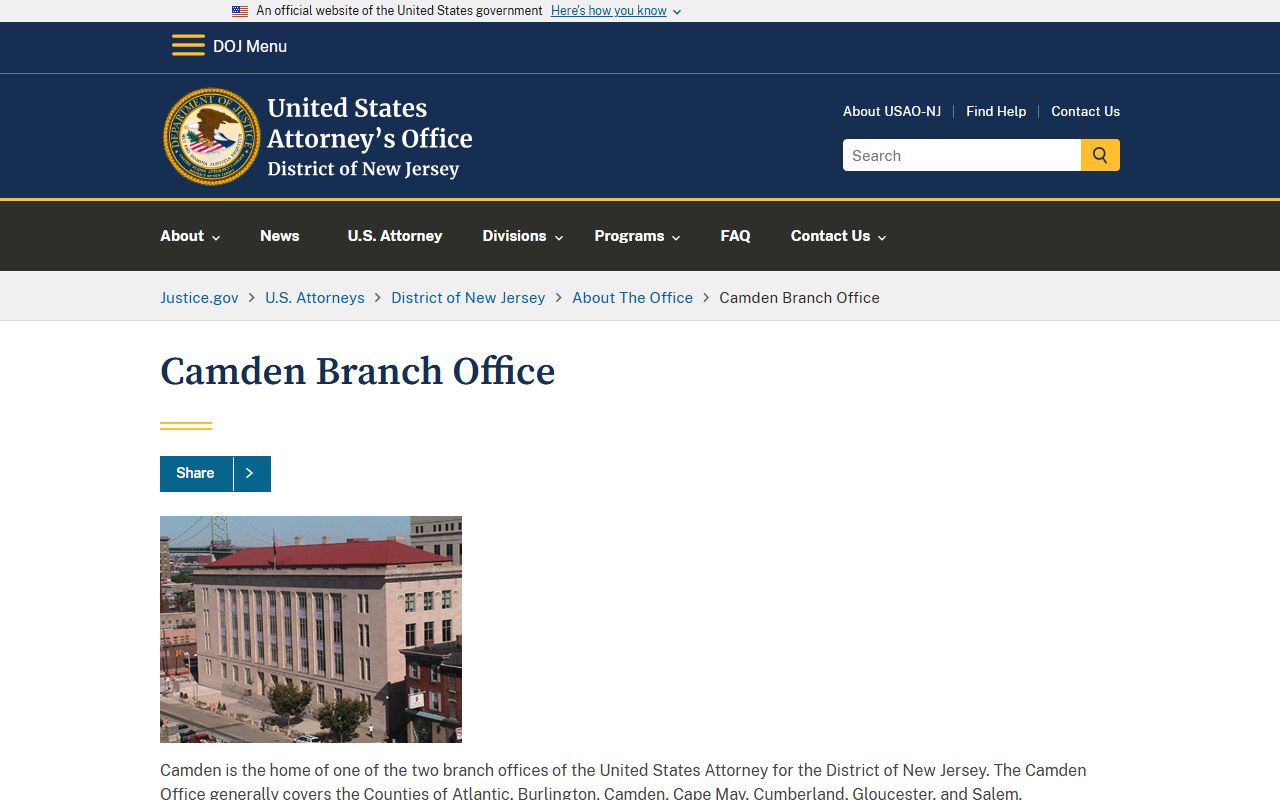
The U.S. Attorney Camden Branch Office is the specific branch that covers federal cases originating in Atlantic County, coordinating with local law enforcement and handling South Jersey matters.
Federal cases are separate from state Superior Court cases. A matter that starts in state court is not automatically transferred to federal court. For a case to go federal, it must raise a federal question, involve diversity of citizenship with the required amount in controversy, or be brought by a federal agency. If you are searching for a case that involves a federal charge or a federal civil claim, search PACER rather than the NJ Courts state portals.
Atlantic County Superior Court Specialty Programs
New Jersey runs a court-supervised treatment program called Recovery Court, formerly known as Drug Court. It is designed for eligible defendants who have substance-use disorders. The program combines intensive supervision, regular court appearances, substance-abuse treatment, drug testing, and a structured system of sanctions and incentives. Eligibility depends on the charges, a clinical evaluation, the applicant's criminal history, and a public-safety screening. Atlantic County, as part of the Atlantic/Cape May Vicinage, participates in the statewide Recovery Court program administered by NJ Courts.
Recovery Court functions through the Superior Court. Participants who complete the program may receive reduced sentences or dismissal of charges depending on program terms and the original case disposition. Those who do not comply face graduated sanctions and possible removal from the program, with the underlying case then proceeding through standard criminal channels. The NJ Courts Criminal Division page covers Recovery Court eligibility and program structure statewide.
The Central Municipal Court's AI communications pilot, launched in 2025, is a different kind of innovation. It provides court information by text message around the clock in English and Spanish. Residents can receive virtual hearing links, schedule notices, FAQ responses, instructional videos, and contacts for the public defender and prosecutor. That kind of automated outreach is unusual for a municipal court and is part of the county's broader effort to reduce missed court dates and improve communication with self-represented litigants.
Expungement of Atlantic County Superior Court Records
Expungement is the legal process that removes or isolates qualifying criminal and related records from public access. Under N.J.S.A. 2C:52-1 et seq., New Jersey's expungement law, a person can petition to have eligible arrests, charges, or convictions removed from the public record. The New Jersey Office of the Public Defender describes expungement as giving people a clean slate for employment, housing, and educational purposes. In 2024, the Public Defender's office launched a dedicated Expungement Unit and reported processing more than 4,500 applications. The OPD Atlantic Region office is at 5914 Main Street, Suite 201, Mays Landing.
Eligibility for expungement depends on several factors. The type of offense matters. Some convictions are not eligible. The number of prior convictions matters. Waiting periods apply. Pending charges can block eligibility. Clean Slate provisions and marijuana-related reforms have expanded eligibility for some categories, but the petitioner still needs to use the correct court process unless automatic relief applies. Once an expungement order is entered, the record is isolated so it does not appear in ordinary public searches. Law enforcement and certain courts may retain limited access for purposes allowed by the statute.
Court sealing under Rule 1:38-11 is a different process. Sealing restricts access to a specific court record or set of documents for good cause shown to the court. It is not the same as expungement of an entire criminal history. Both processes affect what the public can find through the Superior Court portals, but they operate under different rules and procedures.
Related Atlantic County Court Resources
Several other offices and pages connect directly to Superior Court work in Atlantic County. The Clerk of Court page covers the vicinage court office roles, records request processes, and how to get certified copies of Superior Court documents. The court records page walks through the full set of NJ Courts portals for civil, criminal, judgment, and municipal searches. The court dockets page explains what a docket entry shows and how to read case information from the public portals.
For probate and estate matters handled through the Superior Court, Chancery Division, Probate Part, see the Surrogate's Court page. The Surrogate's Office at 5911 Main Street, Mays Landing, and the branch at 1201 Bacharach Boulevard, Atlantic City, handle day-to-day will filing, estate administration, and short-certificate issuance. Contested probate and certain guardianship matters that require a Superior Court judge are handled at the courthouse level.
Legal aid resources for Atlantic County include the New Jersey Office of the Public Defender, Atlantic Region, at 5914 Main Street, Suite 201, Mays Landing, 609-272-9495, for eligible criminal defendants. Self-represented litigants can use NJ Courts self-help materials at njcourts.gov for records requests, court procedures, and forms. Atlantic County's self-help population can also access Central Municipal Court's public defender pathway for eligible municipal matters.
Note: For federal cases, PACER is the correct portal. State court portals do not include federal district court, bankruptcy court, or Third Circuit records.