
How to Search Atlantic County Court Records
New Jersey does not combine every court record in one place. The state runs separate portals for civil case jackets, criminal case data, judgment liens, and municipal traffic complaints. Atlantic County cases follow the same statewide routing. A civil lawsuit goes into the Civil Case Jacket system. A criminal indictment or accusation goes into PROMIS/Gavel. A money judgment or lien goes into the Judgment Search. A traffic ticket or municipal complaint routes to NJMCDirect or the Municipal Court Case Search. Recorded deeds, mortgages, and tax liens are kept by the County Clerk, not the courts, and are searched through a different portal entirely.
Before you start, gather what you know. A full name with correct spelling helps but is not always enough. A docket number is more precise. New Jersey docket numbers contain built-in clues. The divorce example FM-01-07500-00 breaks down as FM for a family dissolution case, 01 for Atlantic County, 07500 for the sequence number, and 00 for the year 2000. Knowing the county code 01 confirms you are looking at an Atlantic County filing. If you have a ticket, the court ID number, ticket number, and license number are all required by the NJMCDirect system.
- Start at the NJ Courts Find a Case page. Pick the system that matches your case type: Civil Case Jacket for civil or foreclosure matters, PROMIS/Gavel for criminal cases, Judgment Search for money judgments and liens, or Municipal Court Case Search for local complaints and tickets.
- Enter the party name or docket number. Use the exact spelling shown on any court papers you have. Name searches can return results from multiple divisions, so narrow by record type when the portal allows.
- Select Atlantic County from the county dropdown when the option is available. This filters results to Atlantic/Cape May Vicinage cases and cuts down on unrelated matches.
- Review the docket entries. You will see party status, hearing dates, documents listed, orders entered, and motion outcomes. The actual text of filed documents is generally not viewable online through the public portals; you see the list of what was filed, not the content.
- If you need a copy or a certified record, use the NJ Courts records request process through the appropriate court division or the Superior Court Clerk's Office. Do not file an OPRA request with the County Clerk for a Superior Court case file; those are Judiciary records, not county agency records.
Note: For older court records not visible in current portals, contact the relevant court division or Superior Court Clerk with the docket number, party names, case type, and approximate year.
Atlantic County Civil Case Jacket Search Fields
The Civil Case Jacket portal is the public-access tool for Superior Court civil and foreclosure case data in Atlantic County. It is reached through the NJ Courts Civil Case Jacket portal after accepting a disclaimer. The portal pulls data from ACMS, the court's civil case management system. You can search by party name or by docket number. The county dropdown narrows results to Atlantic County cases. When searching by name, try all likely spellings because the system does not auto-correct variations. For business parties, search the full registered name.
| Field Label | Type | Required | Notes / Format |
|---|---|---|---|
| Search by | Tab / radio | Yes | Choose party name or docket number before entering any data. |
| Docket Number | Text | Conditional | NJ docket formats use a prefix plus county/year coding. Example: FM-01-07500-00 means Atlantic County Family case from 2000. |
| Party Name | Text | Conditional | Enter the party or business name. Exact spelling matters; the portal does not fuzzy-match. |
| County | Dropdown | Optional | Select Atlantic to filter results to this vicinage. Leaving blank returns statewide results. |
| Search | Button | Yes | Runs the query after fields are filled. |
| Reset / Clear | Button | Optional | Clears all fields if you need to start over. |
The NJ Courts Electronic Access Program page explains which systems feed the civil portal and what data is included or excluded. Actual document text and images are not part of the public case information; only the list of filed documents appears. If you need the content of a motion or order, you must request a copy through the court.
Types of Atlantic County Court Records
Atlantic County's Superior Court handles civil, criminal, family, and probate-related matters across different divisions and buildings. The Civil Courts Building in Atlantic City covers civil and foreclosure filings. The Criminal Courts Complex in Mays Landing handles indictable offenses. The Family Part handles dissolution, custody, support, domestic violence, juvenile, and child welfare matters. Probate and estate functions run through the Atlantic County Surrogate's Office, which also serves as the Probate Part of the Superior Court Chancery Division. Municipal courts handle traffic, parking, local ordinances, and lower-level criminal offenses.
Each division produces its own record type, and those types are searched through different portals. Picking the right category first is the key step.
- Civil records - complaints, answers, motions, orders, judgments, and foreclosure case jackets filed in Superior Court Law Division; searched through the Civil Case Jacket portal.
- Criminal records - indictable offenses and post-indictment proceedings; limited public case-tracking data available through PROMIS/Gavel.
- Family and divorce records - dissolution, custody, and support cases in the Family Part; closed files are eventually archived by the Superior Court Clerk's Office in Trenton; see marriage and divorce records for the full process.
- Probate and estate records - wills, estate administration documents, short certificates, and guardianship filings through the Surrogate's Court; available for public inspection at the Surrogate's Office.
- Judgment and lien records - the Civil Judgment and Order Docket covers statewide liens from 1984 to present; searched through the Judgment Search portal by party name, judgment number, or docket number.
- Municipal and traffic records - tickets, parking violations, local ordinance complaints, and disorderly persons matters; searched through Municipal Court Case Search or NJMCDirect.
What Atlantic County Court Records Show
The fields visible in a public court search depend on the system and the case type. For Superior Court civil matters, the NJ Courts Electronic Access Program describes the data available: case number and docket format, party names and status, attorneys of record, the list of documents filed, orders entered, scheduled proceedings, and motion dispositions. Actual text or images of filed documents are not part of the public EAP case information. Copies require a records request. For criminal cases, PROMIS/Gavel provides limited public tracking data; full criminal history checks for employment or licensing purposes go through State Police or FBI fingerprint channels, not court case portals.
| Field | What It Shows |
|---|---|
| Case Number / Docket Number | Unique identifier with case-type prefix, county code, sequence, and year; use exact punctuation when requesting copies or calling the court. |
| Party Status | Whether a party is active, defaulted, dismissed, settled, substituted, or otherwise dispositioned; one party's status can change without ending the whole case. |
| Attorneys | Names and party representation for attorneys of record in the case. |
| Documents Filed | List of filings and events on the docket; actual text and images of the documents are not included in public online access and require a copy request. |
| Orders Entered | Judge's written directives shown as docket events; content requires a copy. |
| Proceedings Scheduled | Upcoming hearing dates, times, courtroom, and judge; confirm close to the date because adjournments and virtual or in-person status can change. |
| Motion Dispositions | Outcome of motions heard by the court, listed as docket entries. |
| Redactions | Social Security numbers, financial account numbers, minor names, victim addresses, medical and mental health data, and other personal identifiers are redacted from public court copies under Rule 1:38-7. |
The NJ Courts self-help page for court records explains the records request process for copies and certified copies, including the Certificate of Divorce option for family dissolution cases.
The NJ Courts Electronic Access Program page details the four main systems feeding court data: ACMS for civil cases, FACTS for family cases, ATS for municipal/criminal tracking, and CJOD for criminal judgment data. Subscription access provides deeper case information than the free public portals.
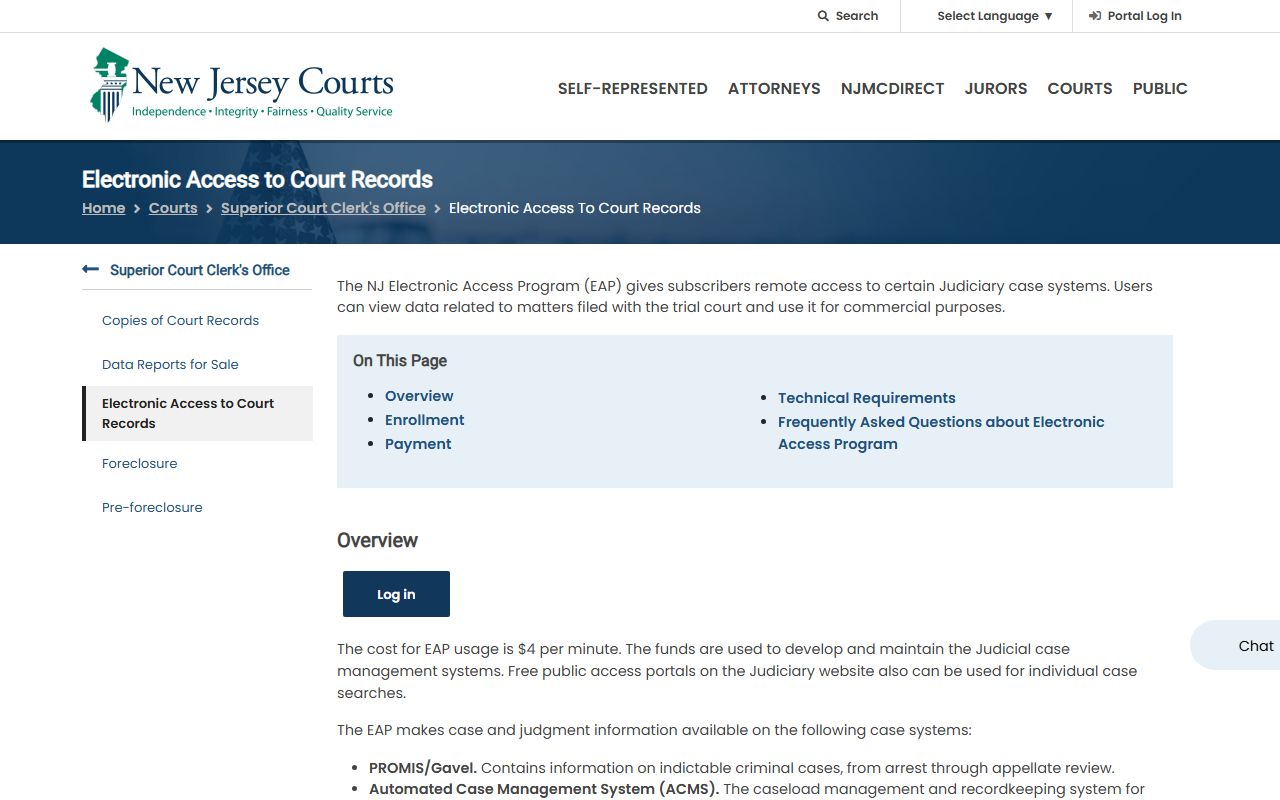
That page is the clearest official source for understanding which system holds which Atlantic County court record type and what the public-access limits are for each.
Public Access Framework for Atlantic County Court Records
New Jersey uses two overlapping but distinct access systems, and the most common mistake is applying the wrong one. The Open Public Records Act, N.J.S.A. 47:1A-1 et seq., governs executive-branch, county, municipal, and other public-agency records. It covers Atlantic County administrative records from the Clerk, Sheriff, and county departments. Courts are different. The Government Records Council explains that the Judicial branch, including the Superior Court, municipal courts, and the Administrative Office of the Courts, is not a public agency under OPRA. Filing an OPRA request with the County Clerk for a divorce judgment or a criminal case file will not work because those are Judiciary records, not county agency records.
Court records are governed by New Jersey Court Rule 1:38. The rule starts with a presumption that court records are open to the public. But the same rule lists exclusions and redactions that limit what actually appears in a public search. Rule 1:38-3 covers excluded record categories. Rule 1:38-7 requires redaction of personal identifiers like Social Security numbers and financial account numbers. Rule 1:38-11 allows sealing by court order for good cause. The practical result is that most Superior Court civil dockets are accessible, criminal case-tracking data is available in limited form, and several categories are walled off entirely. To request a court record, work through the court's own process, contact the vicinage, or use the NJ Courts self-help resources rather than the GRC complaint channel.
For county agency records that are subject to OPRA, an Atlantic County Clerk OPRA request can be submitted using the Clerk's OPRA form. Those requests cover Clerk's Office administrative records, not Superior Court case files. If a requester is denied, the GRC complaint process or a Superior Court action are available. Court-record denials follow a separate Judiciary process.
Key Rule: Court Rule 1:38 and OPRA are separate systems; filing an OPRA request for a Superior Court case record will not produce the file because courts are not OPRA public agencies under N.J.S.A. 47:1A-1.1.
The NJ Courts Self-Help Center provides guides for court record requests, expungement, divorce self-representation, and municipal court navigation, all tailored to New Jersey Superior Court practice.
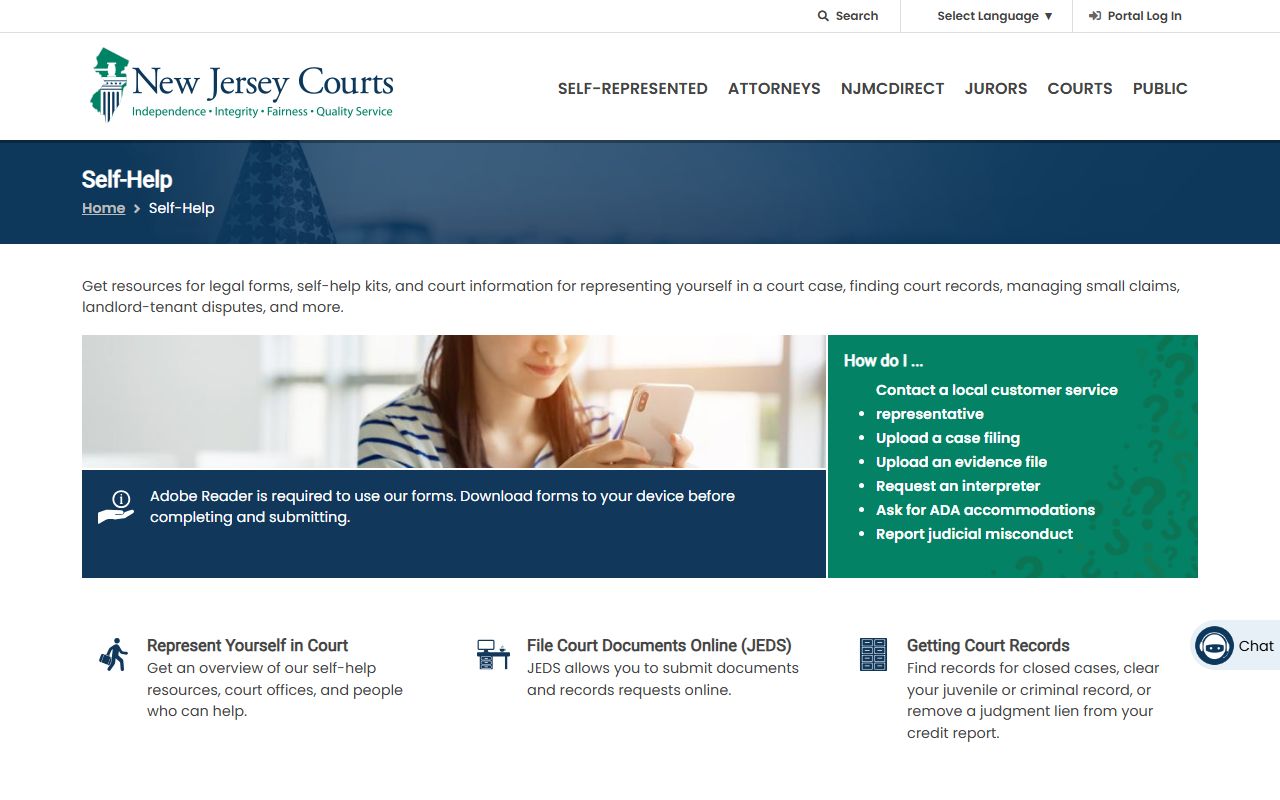
The self-help center is especially useful for people handling their own Atlantic County court record requests, expungement petitions, or divorce certification needs without an attorney.
Sealed and Restricted Atlantic County Court Records
Not every Atlantic County court record is open. Rule 1:38 and several statutes restrict access to a broad set of sensitive materials. Juvenile delinquency records are restricted by both the juvenile statutes and Rule 1:38 exclusions; access may be limited to the juvenile, a parent or guardian, counsel, the prosecutor, and the court. Adoption files are confidential and require court or statutory authorization. Child abuse and neglect records are restricted to protect families. Domestic violence filings can include protected victim addresses, certain sealed documents, and materials restricted to prevent harm. Mental health and civil commitment data are kept private due to medical sensitivity and applicable statutes. Grand jury materials are not public unless they become part of a public proceeding. Search warrant materials are typically sealed until execution or by court order.
Expungement is a separate process from sealing. Under N.J.S.A. 2C:52-1 et seq., eligible criminal and arrest records can be extracted and isolated from public view after a successful petition. The NJ Office of the Public Defender describes expungement as a process that removes a conviction from the state or federal record and gives people a clean slate for work, housing, or education. In 2024, the Office launched an Expungement Unit that processed more than 4,500 applications. Eligibility depends on the type of offense, waiting periods, prior record, pending charges, and statutory exclusions. Once granted, expunged records do not appear in ordinary public searches, although law enforcement and courts retain limited access for purposes allowed by law.
When a public search returns nothing, that is not a legal certificate. A missing result may mean the case is in a different portal, the name is spelled differently, the record is sealed or expunged, the case predates online indexing, or the record was never a public filing. For any purpose affecting custody, travel, employment, licensing, or immigration, verify directly with the office that holds the record.
Note: Sealed, expunged, juvenile, adoption, and confidential records may not appear in public searches; their absence online does not mean the record does not exist.
Copy Types and Certified Records
Atlantic County court records can be obtained in different formats depending on the purpose. A plain copy is an ordinary reproduction of a public record without a court seal or certification. It is often enough for personal reference. A certified copy is authenticated by the custodian or court as a true copy of the original and is typically required for legal proceedings, government applications, and similar official uses. An exemplified copy provides an enhanced certification sometimes needed when the record is used outside New Jersey or in another legal proceeding; verify availability and fee with the issuing court or clerk before requesting one.
For divorce cases, the Superior Court Clerk can often prepare a Certificate of Divorce without the full judgment file. NJ Courts explains that the certificate contains the county of venue, docket number, party names, and final judgment date. It is enough for most purposes and costs less than requesting the full file. Closed divorce files are eventually archived at the Superior Court Clerk's warehouse in Trenton, so older dissolution records may need to be requested by mail or through the Clerk's office with the docket number in hand.
For Surrogate records, a short certificate proves an executor's or administrator's authority to act for an estate. Banks, title companies, motor vehicle authorities, and other holders of titled assets typically require a short certificate before transferring property out of the decedent's name.
In-Person Atlantic County Court Record Requests
Many Atlantic County court records can be accessed online, but some still require a visit or a mailed request. The building you need depends on the case type. Criminal matters and general Superior Court operations route through the Atlantic/Cape May Vicinage main contact. Civil matters are associated with the Atlantic City building. Surrogate records are at the Surrogate's Office on Main Street in Mays Landing. The Mays Landing campus is dense; the Criminal Courts Complex, Central Municipal Court, the County Clerk's main office, and the Surrogate all sit within a short distance of each other. Confirm the correct building before you go.
Atlantic County Criminal Courts Complex
4997 Unami Boulevard
Mays Landing, NJ 08330
609-402-0100
Mon-Fri 8:30 a.m.-4:30 p.m.
Atlantic County Civil Courts Building
1201 Bacharach Boulevard
Atlantic City, NJ 08401
609-402-0100
Mon-Fri 8:30 a.m.-4:30 p.m.
Atlantic County Surrogate's Office
5911 Main Street
Mays Landing, NJ 08330
609-645-5800
Mon-Fri 8:30 a.m.-4:00 p.m.
The Surrogate's Office also maintains a second location at 1201 Bacharach Boulevard, Atlantic City, NJ 08401, phone 609-343-2341, with the same weekday hours. The Surrogate page notes that Spanish-speaking assistance is available. Appointments are encouraged for Surrogate matters. For vicinage contact and court-specific information, the main line for the Atlantic/Cape May Vicinage is 609-402-0100.
Reading Atlantic County Court Records
A docket number is not just a filing number. It carries meaning. The prefix identifies the case type: FM for family/matrimonial, L for law division civil, CR or I for criminal. The county code follows; 01 is Atlantic County. Then comes the sequence number and the two-digit year. When you call the court or mail a copy request, use the exact punctuation and format shown on any papers you have. The wrong format can slow down a search or send it to the wrong office.
Party status labels matter too. A party can be listed as active, defaulted, dismissed, settled, or substituted. Those labels describe that party's position, not the status of the whole case. A case listed as "disposed" or "closed" means the court entered a final action, but post-judgment motions, enforcement, liens, or appeals can still follow. A civil judgment in Judgment Search can affect property and credit independently of what the case jacket shows. When a docket entry lists a document filed but no PDF is available, the document exists in the record; you need to request a copy to see the content.
Charges are not convictions. A criminal docket showing a charge does not mean the person was found guilty. Charges can be dismissed, downgraded, acquitted, or resolved in ways that do not result in conviction. For official criminal history information used in employment, licensing, or immigration contexts, the proper source is a fingerprint-based check through State Police or FBI channels, not a public court case search.
Atlantic County Court Records Glossary
Legal terms appear frequently in court records. Understanding them helps you read a docket correctly and ask the right questions when you contact the court.
- Plaintiff
- The party who starts a civil lawsuit by filing a complaint.
- Defendant
- The party sued in civil court or accused in a criminal case.
- Docket
- The official list of filings and events in a case, maintained by the court.
- Indictment
- A grand jury charging document used for indictable crimes in New Jersey Superior Court.
- Disposition
- The outcome of a charge, claim, or case, such as guilty, dismissed, settled, or defaulted.
- Expungement
- The legal isolation or removal of qualifying criminal or arrest records from public view, governed by N.J.S.A. 2C:52-1 et seq.
- Bench warrant
- A warrant issued by a judge, often after a missed court date or failure to comply with a court order.
More legal terms are defined on the Atlantic County court dockets page, which covers docket entry types in detail.