
What Is an Atlantic County Court Docket
A docket is the court's running log of a case. Every time a document is filed, a hearing is scheduled, a motion is decided, or an order is entered, the court adds a line to the docket. The docket number sits at the top. That number is assigned when the case opens and stays with it for life. The log grows as the case moves. A docket is not the same thing as the case file. The case file is the stack of actual documents, motions, exhibits, and orders. The docket is the index of events and documents, not the documents themselves.
In New Jersey, docket numbers carry encoded information. Take the divorce example found in the NJ Courts records materials: FM-01-07500-00. FM is the case-type prefix for a family dissolution matter. 01 is the county code for Atlantic County. 07500 is the sequence number for that case. 00 is the two-digit year, meaning the case was filed in 2000. Other prefixes tell you other things. L means a Law Division civil case. DC means a Special Civil Part matter. If you have the docket number, enter it exactly as written, including the hyphens and letter prefix, when searching or calling the court.
The state Judiciary's Electronic Access Program, also called EAP, is the subscription system that delivers deeper case data to law firms, government agencies, and professionals. For the public, free portals provide access to much of the same docket information, though the actual text or images of filed documents are not included in public EAP-level access. What you see in the public portal is the list of events, party names, attorney appearances, and hearing dates.
Atlantic County Docket Number Formats
New Jersey uses a standardized docket-number system across all Superior Court divisions. The format encodes the case type, county, sequence, and filing year into a single string. Atlantic County's code is 01. Knowing the prefix helps you confirm you are looking at the right court and division before you call or request copies.
| Prefix | Division / Case Type | Example |
|---|---|---|
| FM | Family dissolution (divorce/dissolution) | FM-01-07500-00 |
| FD | Family non-dissolution (custody, support) | FD-01-XXXXX-XX |
| L | Law Division civil | L-01-XXXXX-XX |
| DC | Special Civil Part (smaller claims) | DC-01-XXXXX-XX |
| F | Foreclosure | F-01-XXXXX-XX |
| CR or IND | Superior Court criminal / indictment | IND-2000-01-XXXXX |
| Municipal complaint | Municipal Court (ticket or complaint) | Court ID + ticket or complaint number |
Note: The county code 01 in the docket string confirms you are looking at an Atlantic County Superior Court matter, not a Cape May or another vicinage case.
How to Search Atlantic County Dockets Online
New Jersey does not use a single unified docket portal. Each case type routes to a different system. The NJ Courts Find a Case page is the best starting point. It lists the available portals and explains what each one covers. Pick the system that matches your case type, accept any required disclaimer, then search by party name or docket number. County filters exist in most portals, so narrow to Atlantic County when the option appears.
- Go to NJ Courts Find a Case and identify the portal that covers your case type.
- For civil and foreclosure matters, open the Civil Case Jacket portal, accept the disclaimer, then search by party name or docket number.
- For criminal Superior Court cases, use PROMIS/Gavel. Enter the defendant name and, if available, the county or case identifiers.
- For money judgments and civil liens, open the NJ Judgment Search and search by party name, judgment number, or docket number.
- For municipal traffic tickets or local complaints, use NJMCDirect with the court ID, ticket number, and license number, or check the Municipal Court Case Search for complaint lookups.
- Review the docket entries that appear: hearing dates, party status, documents listed, and motion outcomes.
- If you need the actual document, contact the court or the Superior Court Clerk to request a copy through the Judiciary's records process.
Superior Court civil case data comes from ACMS, the Automated Case Management System. Criminal case data flows through PROMIS/Gavel. Tax Court matters use a separate Tax Court search. Each system has its own disclaimer page that explains the limits of the data before you search.
Atlantic County Docket Entry Fields
When you pull up a docket in a New Jersey court portal, the results show a set of standard fields. These fields come directly from what the NJ Courts Electronic Access Program and court records pages describe as included in public case information. The table below covers each field and what it tells you.
| Field | What It Shows |
|---|---|
| Docket number | The unique case identifier with type prefix, county code 01 for Atlantic County, sequence, and year. Use exact formatting when requesting copies or calling the court. |
| Court and division | Which Superior Court division handles the case: Law Division civil, Law Division criminal, Chancery Family Part, Chancery Probate Part, Tax Court, or Municipal Court. |
| Parties | Plaintiff and defendant in civil cases; petitioner and respondent in family matters; State of New Jersey and defendant in criminal cases. Status shows as active, defaulted, settled, dismissed, or substituted. |
| Filing date and case status | The date the case opened and its current status: active, disposed, closed, stayed, transferred, or sealed. |
| Attorneys | Attorneys of record and which party each represents. |
| Docket entries | Chronological list of events: complaint filed, answer filed, motion filed, order entered, judgment entered, hearing scheduled, continuance granted, notice filed, warrant issued, plea entered, sentence imposed. |
| Proceedings | Upcoming hearing date, time, court location, courtroom, and assigned judge where available. |
| Documents | List of documents filed in the case. EAP lists the documents but excludes the actual text or image content. Copies of documents require a records request to the court. |
| Financial | Civil judgment amounts, fines, court costs, restitution, or bail/bond conditions where applicable and where publicly visible. |
| Redactions | Social Security numbers, financial account numbers, minor names, victim addresses, medical and mental health information, and other personal identifiers are redacted or excluded under Court Rule 1:38-7. |
When a docket entry lists a document but no PDF appears, that does not mean the document was not filed. It means the copy is held in the case file and must be requested through proper channels.
Criminal Dockets via PROMIS/Gavel
Criminal case dockets in Atlantic County run through PROMIS/Gavel, the public access criminal case tracking system shared by courts, prosecutors, and law enforcement across New Jersey. NJ Courts describes it as the system that provides public access to information from the criminal case tracking system. The public portal gives basic case status and event history for indictable offenses handled in the Atlantic County Superior Court criminal division, located at the Atlantic County Criminal Courts Complex in Mays Landing.
The PROMIS/Gavel public access portal is shown in the screenshot below, captured from the NJ Courts system.
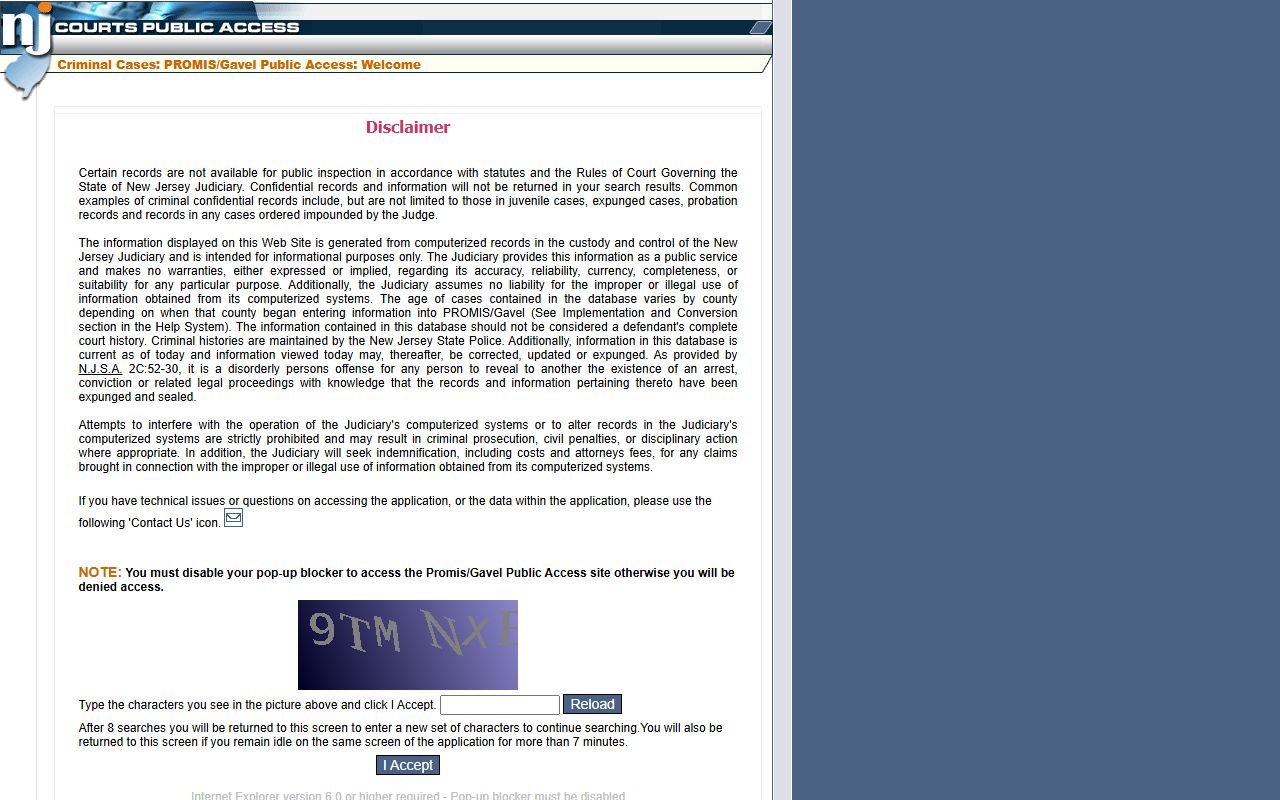
That portal accepts defendant names and county selections. It surfaces limited public data from the criminal case tracking system, not the full case jacket, so indictment details, sentencing records, and full event histories may require direct contact with the Criminal Division at the Mays Landing complex or a formal records request through NJ Courts records.
PROMIS/Gavel is not a criminal-history check. Employers, licensing boards, and immigration cases that need a verified criminal history must go through State Police fingerprint-based channels. A name search in PROMIS/Gavel shows court events, not a background report.
Atlantic County Municipal Court Dockets
Municipal courts handle traffic tickets, parking tickets, local ordinance violations, disorderly persons offenses, and related matters. Atlantic County runs a Central Municipal Court at 5905 Main Street, Mays Landing, serving nine municipalities: Corbin City, Egg Harbor Township, Estell Manor, Galloway Township, Hamilton Township, Linwood, Port Republic, Ventnor, and Weymouth Township. Other Atlantic County towns operate their own local municipal courts. Each has its own court ID in the state system.
Municipal ticket dockets are searched through NJMCDirect, shown in the screenshot below from the NJ Courts portal.
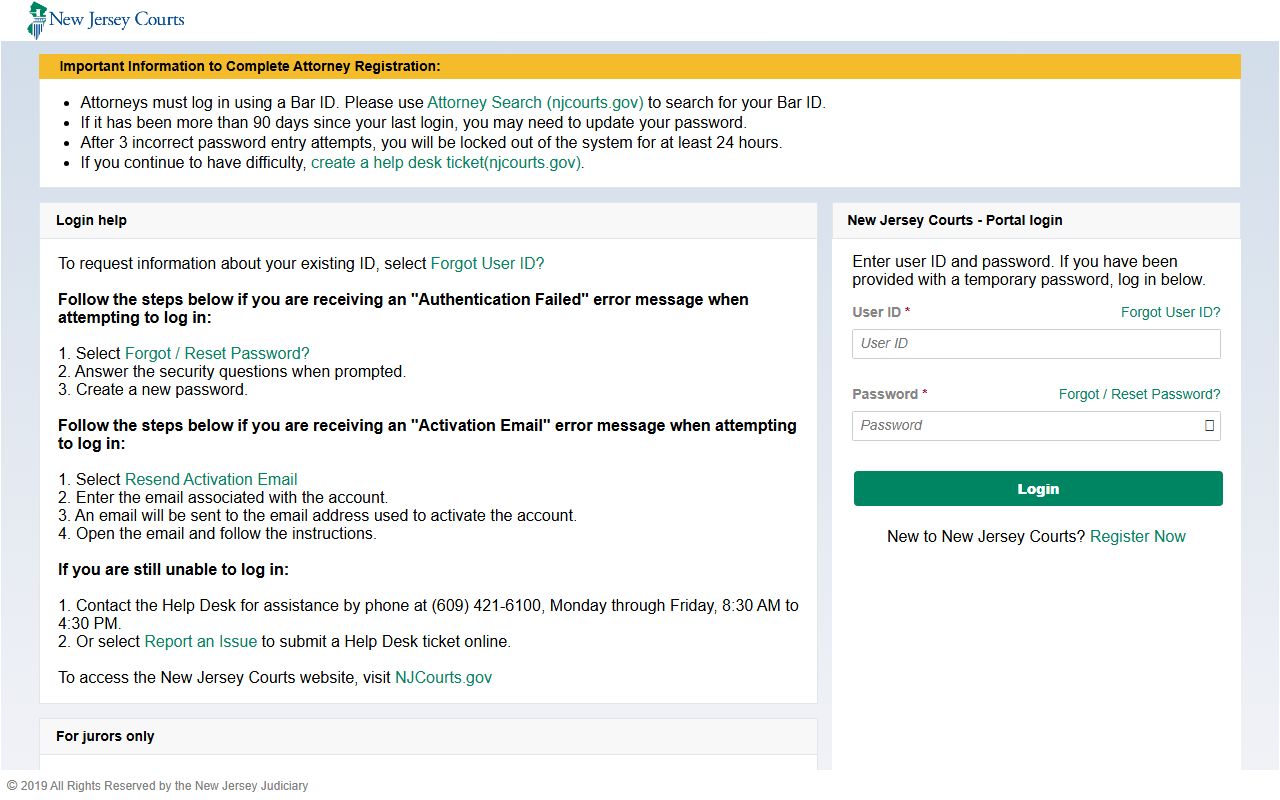
NJMCDirect requires the court ID number, the ticket number, and the license number from the physical ticket. If you do not have those, NJ Courts says the municipal court can help you find them, and statewide assistance is available at 609-421-6100. NJMCDirect is also where eligible municipal matters can be paid, resolved with a plea of not guilty, or scheduled for a different court date. Not every matter is eligible for online resolution. If the system does not allow payment or a plea, the ticket likely requires a court appearance or prosecutor review. For non-traffic complaints through the Central Municipal Court, the email contact is atlcentral.mc@njcourts.gov.
Note: Municipal court records are separate from Superior Court dockets and do not appear in the Civil Case Jacket or PROMIS/Gavel systems.
Civil Judgment Dockets in Atlantic County
Civil money judgments and certain liens are tracked in a separate statewide docket called the Civil Judgment and Order Docket. NJ Courts identifies this as containing statewide lien judgments from 1984 to the present. A judgment entered in Atlantic County Superior Court can appear in this docket and affect property and credit separately from the main case jacket. A creditor who wins a lawsuit and obtains a judgment can also record related instruments with the County Clerk, so judgment searches sometimes require checking both systems.
The NJ Judgment Search portal appears below.
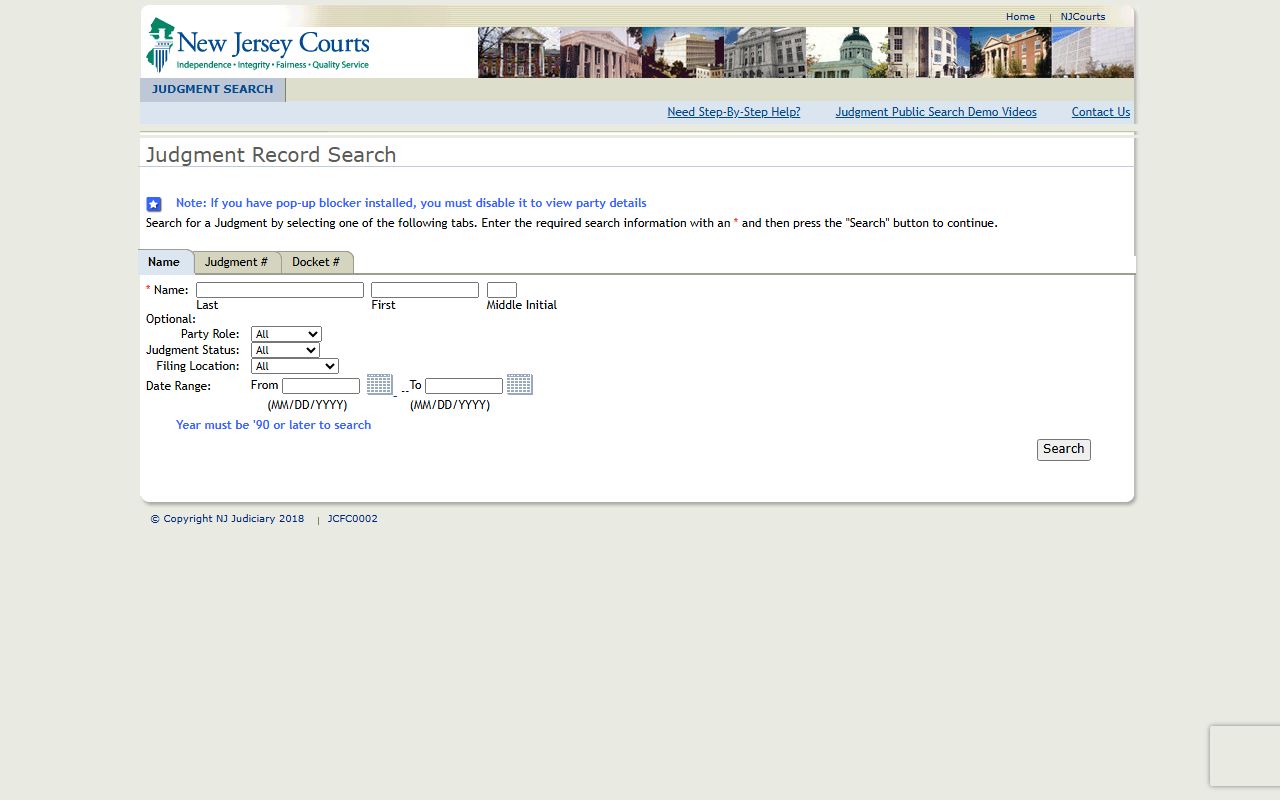
Search by party name, judgment number, or docket number. Results show the judgment debtor, creditor, amount, date, and docket reference. A judgment that shows here is a separate record from the underlying lawsuit docket. If you find a judgment against a property or person, trace the docket number back to the underlying case in the Civil Case Jacket portal for the full case history. This kind of layered check is common in title searches and debt-related research.
EAP Subscriber Access vs Free Public Access
The Electronic Access Program is the New Jersey Judiciary's subscription service. Law firms, government agencies, state and county entities, and credentialed professionals can subscribe to EAP and access real-time, deeper case data across multiple court systems from a single interface. EAP covers ACMS for civil cases, FACTS for family matters, and several other systems. Subscribers pay fees and agree to usage rules. The EAP page on the NJ Courts site explains the systems involved and what each covers.
Free public access uses the same underlying data but through the public portals: Civil Case Jacket, PROMIS/Gavel, Judgment Search, Municipal Court Case Search, and NJMCDirect. The public portals show the core docket fields, party names, hearing dates, attorney appearances, motion outcomes, and docket entry lists. What they do not show is the actual content of filed documents. EAP lists documents filed but excludes text and images from public case information. To get the document text, a subscriber or member of the public must request a copy from the court through official channels.
Put simply: the docket list is public and free. The documents behind the list require a copy request. For Atlantic County court records requests, contact the Superior Court Clerk's Office or the relevant court division. Divorce and dissolution files that have been closed and archived may be held at the Superior Court Clerk's warehouse in Trenton, and the Clerk can prepare a Certificate of Divorce in many cases for a nominal fee.
How to Read an Atlantic County Docket
Docket entries are short lines. Each line normally shows a date, a short description of the event, and sometimes the party or attorney who filed. Court shorthand is common. "MTN" means motion. "ORD" means order. "CMC" often refers to a case management conference. "PJ" can mean partial judgment. A hearing entry with a date and courtroom designation tells you where and when the next court event is. Confirm any hearing date directly with the court shortly before the date because adjournments and virtual/in-person format changes can happen.
Party status codes matter. A party marked "active" is still in the case. "Defaulted" means a party did not respond and the case may proceed without them. "Settled" means that party's claims resolved, though the case might still be open for others. "Dismissed" means removed. "Substituted" means a new party took that position. The overall case status of "disposed" or "closed" usually means the court entered a final action. Even so, post-judgment motions, enforcement actions, and appeals can follow a closed case, so a single docket entry reading "case closed" is not the end of the story.
- Motion
- A written request asking the judge to enter an order. Shows in the docket when filed and again when the judge rules on it.
- Order
- The judge's written directive. An order entry means the judge acted on a request or a hearing.
- Judgment
- A final or enforceable decision resolving rights or money owed. A civil judgment can also appear in the separate Judgment Search docket.
- Continuance
- A postponement of a scheduled court event. Frequent in active litigation; always confirm the new date with the court.
- Bench warrant
- A warrant issued by the judge, often after a party or defendant missed a court date. Visible in criminal dockets.
- Capias
- An arrest process for failure to appear or answer. Related to bench warrants in some criminal matters.
Docket List vs Full Atlantic County Case File
The distinction matters for anyone doing legal research or trying to understand a case outcome. The docket list shows what happened and when. The full case file is the stack of paper: complaints, answers, motions with attached exhibits, hearing transcripts, orders, and judgments. The docket is like an index. The full file is the book itself.
| Docket List | Full Case File | |
|---|---|---|
| What it is | Chronological event log | All filed documents and transcripts |
| Online access | Free public portals; EAP for subscribers | Generally not available online; requires copy request |
| Cost | Free through public portals | Copy and certification fees set by the Judiciary |
| Best use | Track progress, check hearing dates, confirm case exists | Legal review, evidence gathering, certified copy for court use |
| Document images | Not included (EAP lists names only) | Included in official copy from court |
| Who holds it | Judiciary systems (ACMS, PROMIS/Gavel, etc.) | Court clerk or Superior Court Clerk's warehouse in Trenton for archived cases |
Certified copies are usually required for legal proceedings. An uncertified online printout of a docket listing is not a certified court record and will not be accepted in most official contexts. Contact the Clerk of Court or the relevant court division to order a certified copy.
Restricted and Sealed Atlantic County Dockets
Not every docket is publicly visible. New Jersey Court Rule 1:38 presumes court records are open but lists categories excluded from public access. Juvenile delinquency cases, adoption files, child abuse and neglect proceedings, and certain domestic violence filings are restricted. Mental health and civil commitment records are protected. Grand jury materials stay closed until they become part of a public proceeding. Search warrant materials are restricted before execution. These exclusions mean a docket may not appear in any public search even though a case exists.
Personal identifiers are handled separately. Under Rule 1:38-7, Social Security numbers, financial account numbers, driver's license numbers for minors, and similar data are redacted from public court records. A docket you can access will not show those fields. Expunged records are isolated under N.J.S.A. 2C:52-1 et seq. and do not appear in ordinary public searches. A result of "no records found" can mean the case is sealed, the name is misspelled, the record is expunged, the case predates online indexing, or the case is in a different court system entirely. It is not a legal confirmation that no case exists.
For criminal records affected by expungement, the NJ Office of the Public Defender runs an Expungement Unit. Eligibility depends on the type of conviction or arrest, waiting periods, prior record, and statutory exclusions. Sealed records require a court order to unseal and go back to the court that holds the file.
Older and Archived Atlantic County Dockets
Online indexes do not go back forever. The NJ Courts records page states that closed divorce cases eventually move to the Superior Court Clerk's warehouse in Trenton, and timing varies by county. The same general principle applies across court types: when a case no longer appears in a current online portal, contact the relevant court division or Superior Court Clerk with the docket number, party names, case type, county code, and approximate filing year. Older criminal matters may require direct contact with the Criminal Division at the Atlantic County Criminal Courts Complex.
For recorded land documents at the County Clerk, the Clerk's public search portal provides index access back to March 2000 for viewable document images, with earlier documents continuing to be added as imaging progresses. Pre-2000 recorded instruments use book and page references. That land record system is separate from any court docket. Do not search the Clerk's portal for a divorce judgment or criminal case. The Clerk holds recorded deeds, mortgages, liens, trade names, and similar instruments, not Superior Court case files. See the Atlantic County court records page for a full breakdown of which office holds which type of record.
Note: For any legal, employment, immigration, or safety-sensitive use, verify details directly with the official custodian and do not rely solely on online portal results.