
New Jersey OPRA and Atlantic County Records
New Jersey's Open Public Records Act, N.J.S.A. 47:1A-1 et seq., sets the baseline rule: government records must be readily accessible to the public unless a specific protection applies. The law covers state agencies, county agencies, and municipal agencies. It does not cover the Judiciary. That last point is not a loophole or an oversight. The Government Records Council FAQs make it plain that the Judicial branch is not a public agency under OPRA, and court records follow their own disclosure rules.
For Atlantic County, this means a request to the County Clerk's office, the Sheriff's office, the Board of County Commissioners, the Department of Public Safety, or any other county agency goes through OPRA. Those agencies must respond within the time frames the statute sets, must provide access to qualifying records, and must explain any denial in writing. A requester who is denied has two appeal routes: file a complaint with the Government Records Council or bring a lawsuit in the Superior Court. Neither of those routes applies when you want a divorce judgment or a criminal docket from the Superior Court. That request goes to the Judiciary through its own process.
The GRC administers OPRA. It handles education, complaint mediation, and formal decisions on denial disputes. GRC decisions are public records themselves and are searchable on the GRC site. Atlantic County agencies are bound by those decisions in the same way as any other county public agency in New Jersey.
The NJ OPRA Central portal is the state's hub for the Open Public Records Act, offering guidance, model forms, and links to agency custodians.
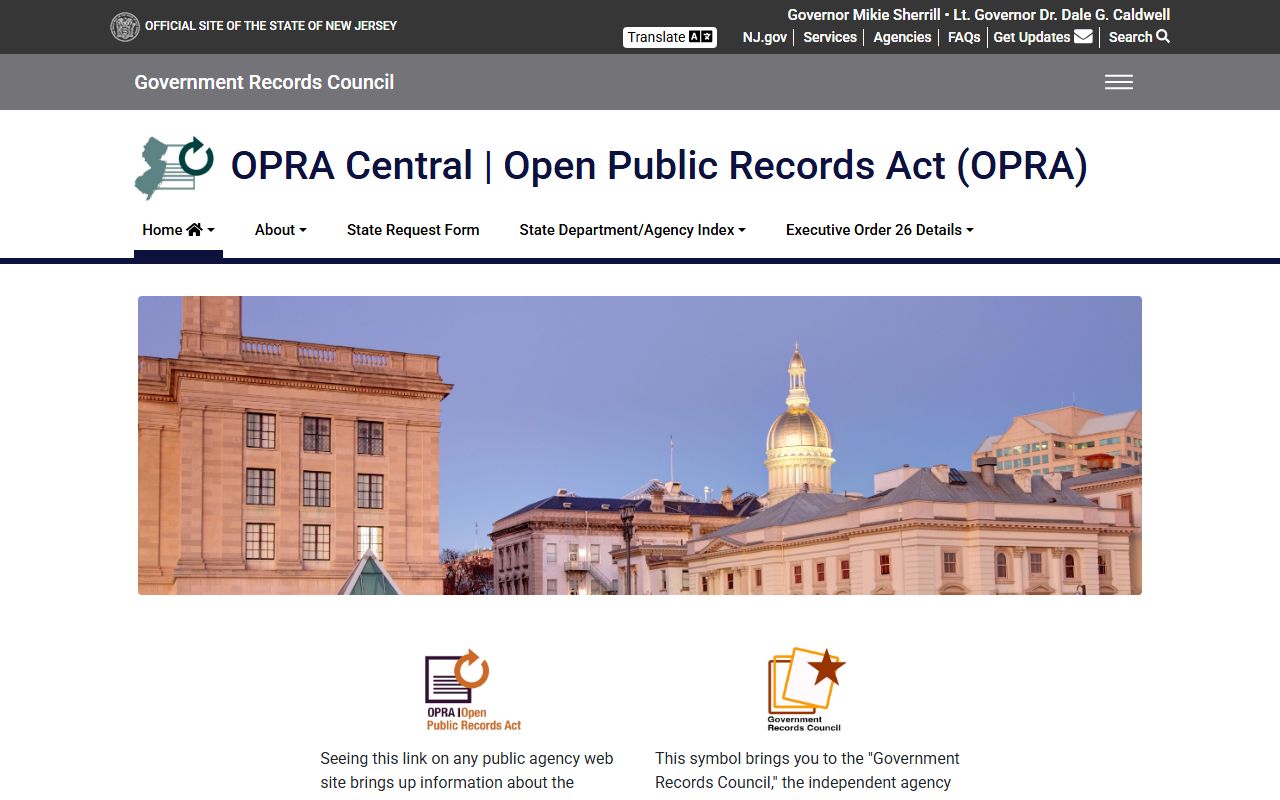
That portal is the first stop when you are unsure which agency holds a record or need help drafting a request for Atlantic County public records.
Atlantic County Records: Two Systems, One County
New Jersey's split between OPRA and the court-records rules creates a real practical divide for anyone trying to track down Atlantic County documents. The chart below lays out which system applies for the most common record types people actually search for.
| Record Needed | Official Starting Point | Why |
|---|---|---|
| Superior Court civil case docket | NJ Courts Civil Case Jacket / vicinage | Judiciary record under Rule 1:38, not County Clerk OPRA. |
| Superior Court criminal case status | PROMIS/Gavel / Criminal Division | Criminal tracking data lives in the Judiciary/prosecutor system. |
| Divorce certificate or closed divorce file | NJ Courts / Superior Court Clerk's Office | Dissolution records are Family Division records; closed files may archive in Trenton. |
| Recorded deed, mortgage, lien, lis pendens | Atlantic County Clerk Official Records Public Search | County Clerk is the recording office for land and recorded instruments. |
| Probate will or estate administration | Atlantic County Surrogate | Surrogate files wills and estate administration documents. |
| Municipal traffic ticket | NJMCDirect / Municipal Court Case Search / municipal court | Traffic and local complaints are municipal matters. |
| County administrative record (budget, contract, report) | Proper Atlantic County department OPRA custodian | OPRA applies to county agencies unless a specific exemption covers the record. |
| Current jail custody | Atlantic County Jail Records / Justice Facility (609-909-7551) | No official public jail roster; custody status should be confirmed directly by phone. |
Note: Filing an OPRA request with the County Clerk for a Superior Court divorce judgment is one of the four most common errors in Atlantic County public records searching and will result in a denial or redirect.
The Government Records Council administers OPRA, hears denial complaints, and publishes guidance on what is and is not a government record in New Jersey.
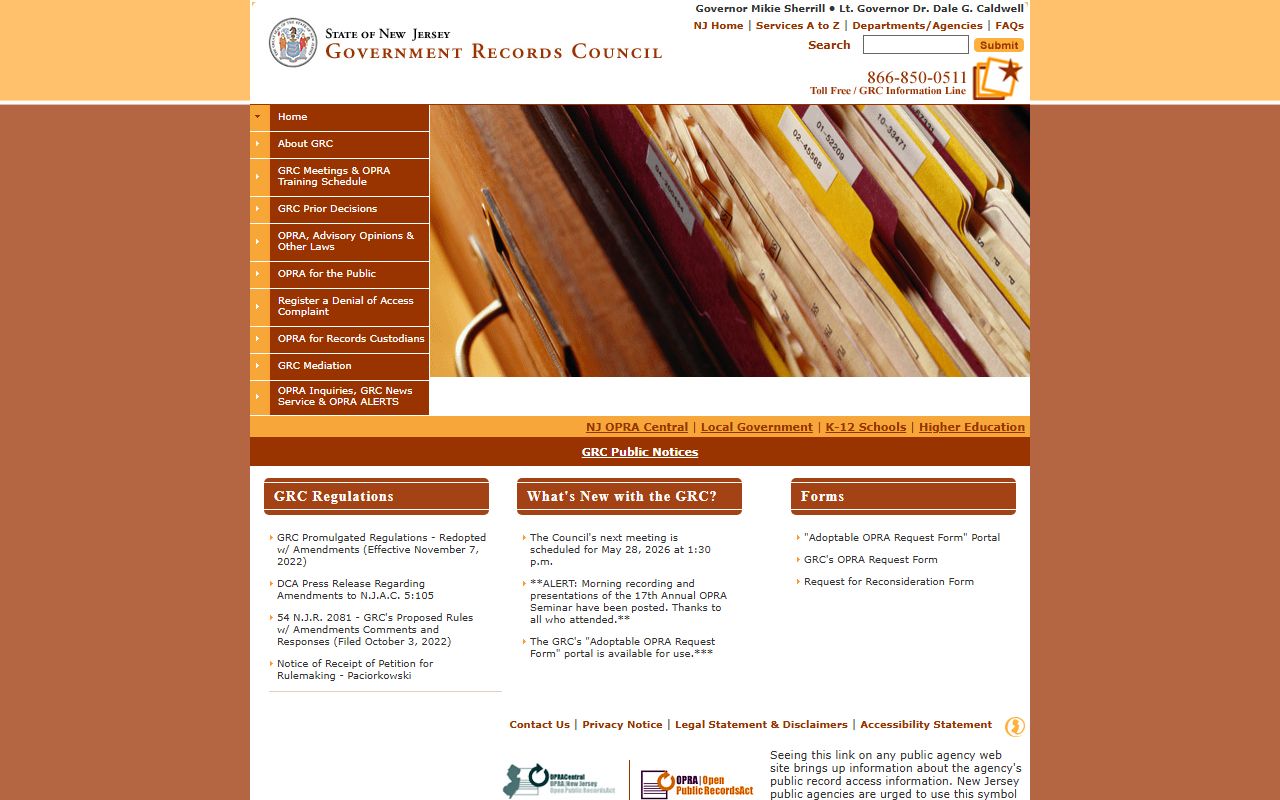
The GRC site lists decisions, model forms, and county custodian contact information that helps requesters target the right Atlantic County office.
Key Atlantic County Public Records Statutes
Five statutes and rules do most of the work in New Jersey's public records framework. Understanding even the basics of each one tells you what you can get, how fast, and what to do if you are turned down.
Statute Callout: New Jersey Public Records Law
N.J.S.A. 47:1A-1 - OPRA's policy statement. Government records shall be readily accessible unless protected; limitations should be construed in favor of public access.
N.J.S.A. 47:1A-1.1 - Definitions. Defines "government record" and "public agency" and lists broad exemptions; the Judiciary is excluded from the public-agency definition.
N.J.S.A. 47:1A-5 - Procedure and access. Covers how agencies must handle requests, response timelines, copy methods, and fee rules. Also provides immediate access to certain recent budgets, contracts, and vouchers not older than 24 months.
N.J.S.A. 47:1A-6 - Denial challenges. Gives requesters the right to challenge a denial before the Government Records Council or in Superior Court.
Court Rule 1:38 - Public access to court and administrative records. Presumes court records are open, then lists exclusions for juvenile, adoption, mental health, grand jury, and other protected categories. Rule 1:38-7 requires redaction of personal identifiers; Rule 1:38-11 controls sealing by court order.
The full text of OPRA is posted on the GRC OPRA law page. That page is the authoritative reading copy for the act as amended.
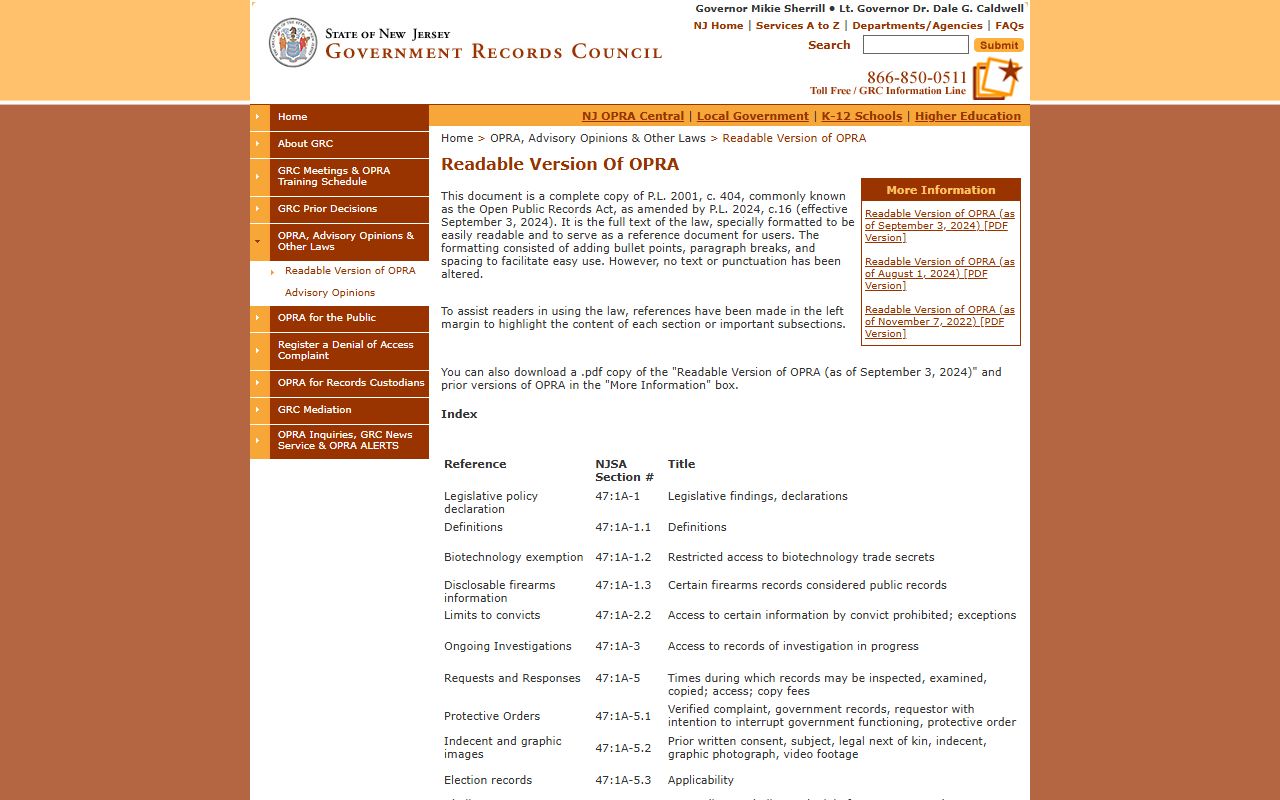
Reading the statute directly removes ambiguity about which records qualify and which agency is responsible for responding to an Atlantic County public records request.
Records the Atlantic County Clerk Maintains
The Atlantic County Clerk, Joseph J. Giralo, is a separately elected official whose office is the recording authority for land-related documents and several other county records. The Clerk does not keep Superior Court case jackets. What the Clerk does hold is a substantial and searchable body of recorded instruments that covers decades of real estate transactions, business filings, and related county documents.
Recorded documents available through the Atlantic County Clerk Official Records Public Search include deeds, mortgages, assignments, releases, UCC financing statements, federal tax liens, tax sale certificates, lis pendens, powers of attorney, notices of settlement, and related real-estate instruments. The search portal gives free guest access to the full index with no password required. Document images starting from March 2000 are viewable online. For the Clerk's full role, see the Atlantic County Clerk page.
- Deeds and deed transfers, including realty transfer fee forms
- Mortgages, assignments, cancellations, and releases
- UCC financing statements, amendments, continuations, and terminations
- Federal tax liens and releases
- Trade Name Certificates and amendments
- Lis pendens and notices of settlement
- Powers of attorney recorded with the Clerk
OPRA requests for Clerk administrative records, policies, or correspondence use the Clerk's own OPRA form, available at the main office or downloadable from the Clerk's site. That form is for the Clerk's office only. It is not the right form for county-agency records held by other departments.
Atlantic County Clerk OPRA Request Form Fields
The Atlantic County Clerk uses its own OPRA request form for records held by the Clerk's office. The form is available at the Historic Court House Complex, 5901 Main Street, Mays Landing, and as a downloadable PDF from the Clerk's forms page. OPRA requests must be in writing. Oral requests do not trigger the statutory response obligations. The table below shows every field the Clerk's OPRA form captures.
| Field | Required | Notes |
|---|---|---|
| Requestor name | Yes | Identifies the person making the request. |
| Mailing address | Yes | Needed for correspondence and mailed copies. |
| Phone / fax / email | Optional/conditional | Contact details for clarification and delivery confirmation. |
| Preferred delivery method | Optional | Inspect in person, paper copy, certified copy, email, fax, or mail; available options may depend on form version. |
| Records requested | Yes | Must identify the government record sought; specific enough for the Clerk to locate the file. |
| Date submitted / signature | Yes | OPRA requires a written, signed request; date establishes the response deadline. |
| Fees / copy costs acknowledgement | Conditional | Paper copies are charged at the statutory rate or actual duplication cost, whichever is higher; form may note this obligation. |
Other Atlantic County departments use their own OPRA custodians. The NJ OPRA Central portal maintains a directory of agency custodians across the state to help requesters reach the right office directly.
How to File an Atlantic County OPRA Request
Filing an OPRA request is straightforward if you identify the right agency first. Each Atlantic County department has its own records custodian. Requests go to the custodian for the agency that actually holds the record you want. Sending a request to the wrong office does not extend your statutory deadline or obligate that office to forward it. These steps apply to county-agency records subject to OPRA; they do not apply to Superior Court records, which use the NJ Courts request process.
- Identify the right agency. Decide which Atlantic County department made or maintains the record. Budgets and contracts are with the appropriate county department or the County Clerk's office; police or arrest records may be with the Sheriff or local municipal police; recorded land instruments are with the County Clerk's recording office.
- Locate the custodian. Each public agency designates a records custodian. The GRC FAQs explain the custodian's role and how to find one. The NJ OPRA portal lists many custodians by agency.
- Write a clear description of the records you want. Identify the record by document type, date range, subject matter, or any reference number. Overly vague requests can slow or limit the response. Be specific but do not narrow so tightly that legitimate variants of the record are excluded.
- Submit the request in writing. Use the agency's OPRA form or a written letter. Mail, email, fax, or hand delivery are all acceptable under OPRA. Keep a copy and note the submission date; the agency's response deadline runs from the business day the custodian receives the request.
- Wait for the response. Under N.J.S.A. 47:1A-5, the custodian must respond as soon as possible but no later than seven business days after receiving the request. For records in immediate-access categories such as budgets, bills, vouchers, and contracts not older than 24 months, the response should be immediate.
- Pay applicable fees and receive the records. Paper copies are charged at the statutory rate per page or actual duplication cost, whichever is higher. Electronic records in an agency's custody may have different cost structures. The agency must state the fee before it charges you, and you may object if the fee appears excessive.
- If denied, use the right appeal route. Under N.J.S.A. 47:1A-6, a requester denied OPRA access can file a complaint with the GRC or sue in Superior Court. The GRC complaint is free and often faster. A Superior Court action may be appropriate if the GRC has limited authority over the specific agency or the matter requires injunctive relief.
GRC OPRA FAQs and Atlantic County
The Government Records Council publishes detailed FAQs that answer the questions most people have before they file a first OPRA request. The FAQs explain what counts as a government record, what a public agency is, why the Judiciary is excluded, how the seven-business-day deadline works, what immediate access means, and how the denial complaint process runs. They also address common gray areas such as whether emails are government records (generally yes, if they relate to agency business), whether agencies can charge for staff time spent searching (subject to specific rules), and whether a requester must explain why they want a record (no).
The GRC OPRA FAQs page is updated when the law or GRC practices change, so it is the most reliable quick-reference for any Atlantic County OPRA question.
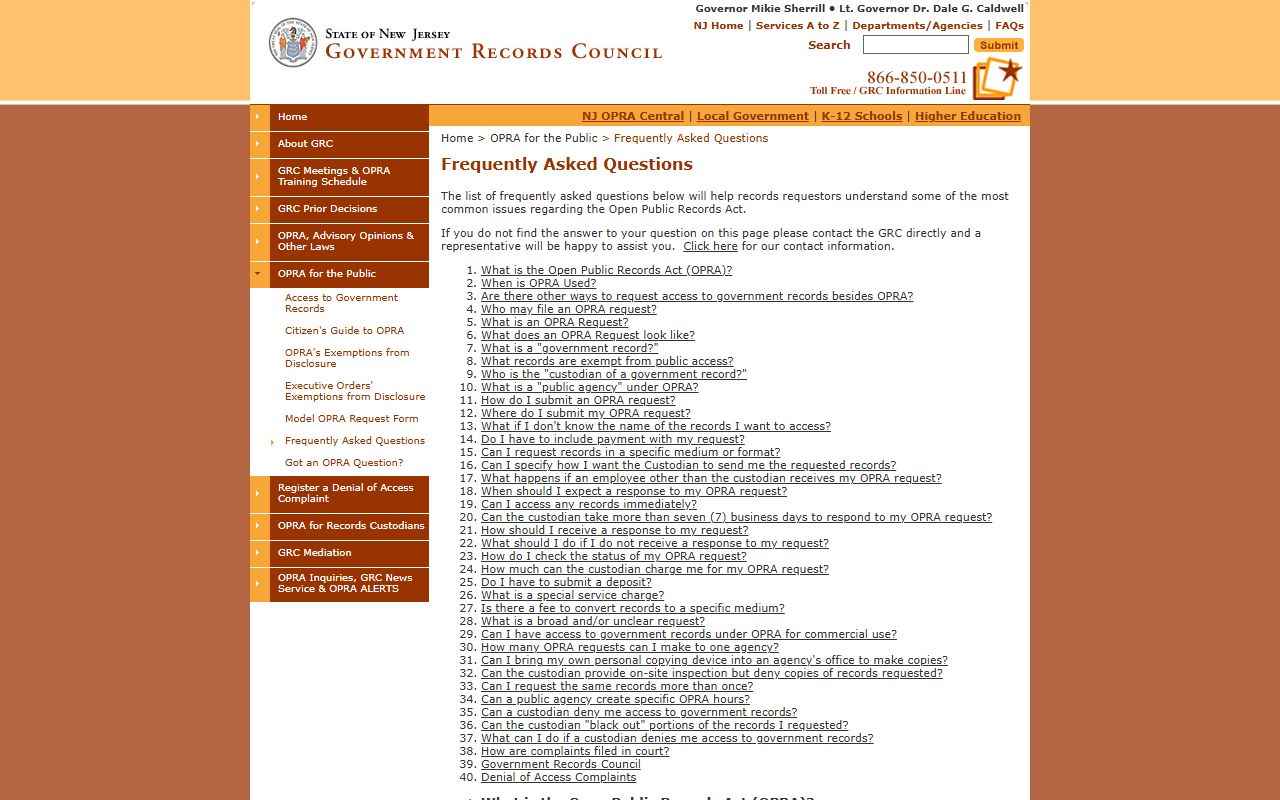
Those FAQs also address the Judiciary exclusion directly, which saves requesters from sending OPRA requests to court offices that are not obligated to respond under the act.
Court Records Access in Atlantic County
Atlantic County Superior Court records are governed by New Jersey Court Rule 1:38, not OPRA. Rule 1:38 presumes court records are open to the public unless a specific exclusion applies. The rule's exclusions cover a meaningful list of categories: juvenile delinquency files, adoption records, child abuse and neglect matters, mental health and civil commitment proceedings, grand jury materials, search warrant applications before execution, and records sealed by court order. Rule 1:38-7 requires that personal identifiers such as Social Security numbers and full financial account numbers be redacted from public court copies. Rule 1:38-11 sets the process for seeking a court order to seal a record.
To look up Atlantic County Superior Court records, use the NJ Courts portals. Civil and foreclosure case jackets search through the Civil Case Jacket system. Criminal cases search through PROMIS/Gavel. Civil money judgments and liens search through the statewide Judgment Search. For certified copies or full document text, request through the court's records process or the Superior Court Clerk's office. See Atlantic County court records for the step-by-step portal walkthrough and the complete search-field inventory for each system.
Closed divorce files are a common source of confusion. NJ Courts explains that dissolution cases in the Family Division are filed at the county level, but closed files are eventually archived by the Superior Court Clerk's Office warehouse in Trenton. A Certificate of Divorce is often sufficient as proof of divorce and is obtainable through the Superior Court Clerk / vicinage office. That certificate carries the county of venue, docket number, party names, and final judgment date.
Note: A request to the Atlantic County Clerk's recording office for a Superior Court divorce judgment is a common routing mistake; the Clerk does not maintain Family Division dissolution records.
Atlantic County Records That Are Exempt
OPRA's broad presumption of access comes with statutory exemptions. Some apply to specific document types; others protect categories of information within an otherwise public record. Knowing what is exempt helps set realistic expectations before you file.
Common exemptions that appear in Atlantic County OPRA requests include personal privacy interests for individuals, ongoing criminal investigation records while an investigation is active, attorney-client communications between the county and its lawyers, trade secrets and proprietary business information submitted to the county, records that are part of a deliberative process in some contexts, and various statutory exemptions for specific programs or agency types. The GRC FAQ and GRC decisions provide detailed guidance on how each exemption is applied and what a custodian must do to invoke it properly.
- Personal privacy interests protected by a clear privacy expectation
- Active criminal investigation records (until investigation closes)
- Attorney-client privileged communications
- Trade secrets and proprietary commercial information
- Deliberative-process materials in limited circumstances
- Records specifically protected by other state or federal statutes
An agency invoking an exemption must tell the requester in writing which exemption applies and why. A blanket refusal with no stated basis is not a valid OPRA denial and can be challenged at the GRC or in court.
If Your Atlantic County Request Is Denied
A denial under OPRA is not the end of the road. N.J.S.A. 47:1A-6 gives every requester two paths. The first is a complaint to the Government Records Council. The GRC process is free, and it starts with a denial-of-access complaint form available on the GRC site. The GRC may mediate the dispute or issue a formal decision. Many denials resolve at the mediation stage. If the GRC issues an adverse decision against a public agency, the agency can be ordered to release the records and, in some cases, pay a requester's attorney fees and a civil penalty.
The second path is a direct action in the Superior Court. This route may be faster in some situations, especially when the requester needs emergency access or the GRC lacks clear jurisdiction. If a court finds an agency unlawfully denied access in bad faith, the requester can be awarded attorney fees and costs under the statute. Some requesters use both paths simultaneously, though legal advice on that strategy is worth getting before you proceed.
For court records denied under Rule 1:38, the process is different. Court record disputes go through the Judiciary's own procedures, not the GRC. A requester contesting a court denial generally must seek relief from the court that holds the record, possibly through a motion or formal request to the assignment judge.
Legal Services of New Jersey offers free civil legal help to eligible residents and can assist with OPRA questions and other public records issues.

Legal Services of NJ is a strong starting point for Atlantic County residents who need help navigating a denied OPRA request or identifying whether a court records request follows the right channel.
Atlantic County Public Records Fees
OPRA sets specific copy fees that apply to requests for paper records from county agencies. The statutory rate governs unless the actual duplication cost is higher. The Atlantic County Clerk OPRA form notes that copies may be purchased for the fee established by applicable statute or regulation, with actual costs applying where duplication costs exceed regular rates. Electronic records may carry different cost structures depending on format and the work required to produce them.
Fees for court records, Surrogate records, and County Clerk recorded instruments are set separately by the Judiciary, the Surrogate's fee schedule, and the Clerk's recording fee schedule. Those are not OPRA copy fees. The table below is limited to the OPRA fee and common Clerk recording fees from official sources. Court-copy fees should be confirmed with the court or Superior Court Clerk at the time of request.
| Item | Amount |
|---|---|
| Letter/legal paper copy (OPRA statutory rate, per page) | $0.05 per page (standard NJ statutory rate) |
| Actual duplication cost (when higher than statutory rate) | Varies by agency; agency must state fee in advance |
| Deed recording, first page (County Clerk) | $40 |
| Deed recording, each additional page | $10 |
| Mortgage assignment, first page | $40 |
| Cancellation of mortgage | $20 |
| Federal tax lien filing | $25 |
| UCC financing statement | $25 |
| Trade Name Certificate | $50 |
| Indexing fee per name over 5 | $6 per additional name |
Note: The NJ OPRA statutory per-page copy rate applies to paper copies; agencies may charge differently for electronic production where the actual cost exceeds that rate.
Common Atlantic County Public Records Mistakes
Four specific errors come up repeatedly when people try to access Atlantic County records. Each one sends the requester to the wrong office and wastes time. Knowing them in advance means a faster, cleaner request.
The first mistake is filing an OPRA request with the County Clerk for a Superior Court divorce judgment. The Clerk's recording office does not keep Family Division dissolution files. Divorce records are court records held by the Superior Court's Family Division, with closed files archived by the Superior Court Clerk's Office in Trenton. The right starting point is the NJ Courts records process, not the County Clerk OPRA form.
The second mistake is searching the Clerk's land portal for criminal cases. The Atlantic County Clerk Official Records Public Search indexes deeds, mortgages, UCC filings, tax liens, lis pendens, and similar recorded instruments. Criminal case data lives in PROMIS/Gavel and the Criminal Division of the Superior Court. The Clerk's portal does not hold criminal case jackets.
The third mistake is searching NJDOC for a county jail detainee. NJDOC's incarcerated person search covers state prison inmates, not people held in the county jail pending trial or serving a county sentence. Atlantic County jail custody questions go to the Justice Facility at 609-645-5855 or jail records at 609-909-7551.
The fourth mistake is treating NJMCDirect as a full criminal history search. NJMCDirect is a municipal ticket and complaint payment system. It shows traffic violation information tied to a specific ticket, court ID, and license number. It is not a statewide or county criminal record search and should not be used as a substitute for a background check through State Police or FBI channels.